gemini 4 isn't out yet — here's what actually shipped.
No — Gemini 4 is not out. On July 21, 2026 Google said its pre-training had just started. What actually shipped that day is Gemini 3.6 Flash — cheaper, faster, and available right now.
The internet spent a day hyping “Gemini 4 is coming.” Here's the calmer, more useful read from someone who ships with these models daily — 16B+ views in the portfolio, 1,500+ AI videos. One real thing did happen, but it isn't the one the headlines picked: Google confirmed it has begun training its next flagship — work that's still months from a product — and, on the same day, quietly released two Flash models you can use this afternoon.

Still no Gemini 4. Three and a half weeks after the announcement there is no gemini-4 in Google’s own model list — checked again today. Two things have changed since this piece was published: Gemini 3.7 Flash shipped and is now the newest Flash model, and the price you actually pay is lower than the list price quoted below — $0.75 / $3.75 per 1M tokens for both 3.6 and 3.7 Flash until 31 December 2026, after which it doubles to the $1.50 / $7.50 you see here. Everything else in this article stands as reported on 21 July.
Logan Kilpatrick — product lead for Google AI Studio — posted: “We have started our most ambitious pre-training run yet, for Gemini 4.” That's the first step of a long pipeline, not a launch.
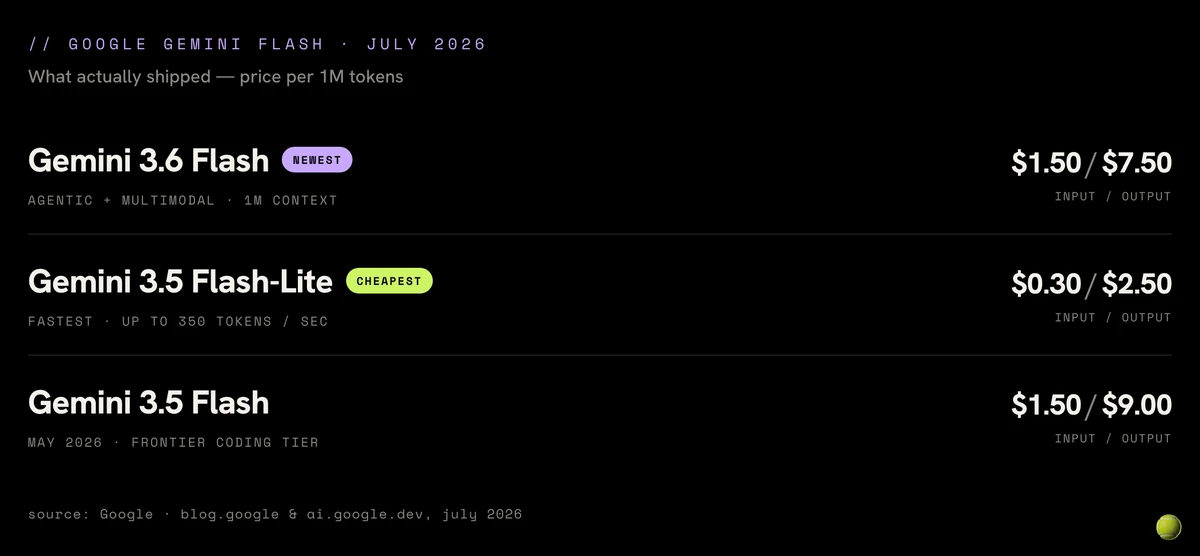
The same day, Google shipped Gemini 3.6 Flash ($1.50 / $7.50 per 1M tokens, agentic + multimodal) and Gemini 3.5 Flash-Lite ($0.30 / $2.50, up to 350 tokens/sec) — plus a security model, Gemini 3.5 Flash Cyber. Sources: blog.google, deepmind.google.
So is Gemini 4 out? No — and here's why that matters
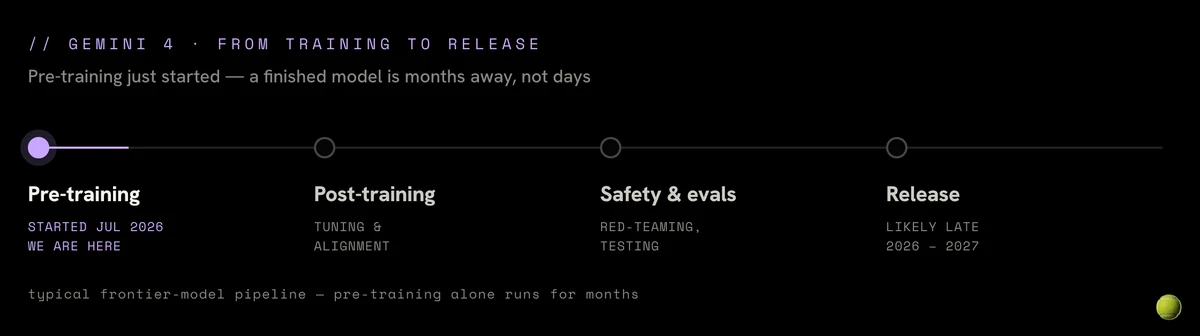
A pre-training run is the first and most expensive phase of building a model: feeding it a massive dataset so it learns general patterns, before any of the work that turns a raw model into a product. At frontier scale, that phase alone commonly runs for months on huge compute clusters. Then comes post-training — instruction-tuning, reinforcement learning from human feedback, evaluation, red-teaming — which historically adds more months.
So when Kilpatrick said pre-training had just started, the honest translation is: Gemini 4 doesn't have a finished base model yet, let alone a tuned, tested, shippable one. A realistic window, based on how this has played out before, is late 2026 into 2027 — not weeks, not “any day now.”
The signal isn't “Gemini 4 is here.” It's “Google is confident enough in the run to say it out loud.” Useful — but not a release date.
What actually shipped: Gemini 3.6 Flash & 3.5 Flash-Lite
The usable news is the cheap, fast end of the lineup. Gemini 3.6 Flash is the new default workhorse for code, multimodal tasks and agents — and it uses 17% fewer output tokens than 3.5 Flash (per the Artificial Analysis Index), with a 1M-token context window. Gemini 3.5 Flash-Lite is the fastest and cheapest, up to 350 tokens/second, and on some coding and computer-use benchmarks it beats the older, bigger Gemini 3 Flash (SWE-Bench Pro 54.2% vs 49.6%; OSWorld 74.0% vs 65.1%).
Prices tell the story better than adjectives — here's what landed on July 21:
Where Gemini 4 sits — and when it might ship
Everything usable today — Gemini 3.1 Pro, 3.5 Flash, 3.5 Flash-Lite, and the new 3.6 Flash — is still the Gemini 3.x line. July 21 was really two separate stories on one day: an incremental 3.x update you can use now, and confirmation that the next generation has only just begun training. Keep them apart — one is a product, the other isn't yet.
A side-by-side demo made the rounds showing Gemini 3.6 Flash building a richer interactive 3D simulation than the larger Gemini 3.1 Pro — one data point, not a benchmark, but a clear sign the cheap tier keeps closing the gap on the flagship tier.
The sleeper release: Gemini 3.5 Flash Cyber
The most striking launch got the least noise. Gemini 3.5 Flash Cyber is a specialized security model (deployed through Google's CodeMender platform) built to find and fix software vulnerabilities. On Google's own test against the V8 JavaScript engine it flagged 55 confirmed issues — versus 47 for mainline 3.5 Flash and 36 for Claude Opus 4.6 — and found 10 vulnerabilities no other model caught.
One caveat worth stating plainly: that's Google's own published benchmark, and access is a limited pilot for governments and vetted partners — you can't just try it. But the direction is real: AI that hunts security bugs at scale is arriving fast. Source: deepmind.google.
What this actually changes for your ads and content
Here's the part that matters if you make content or ads, not if you collect model releases. At $0.30–$1.50 per million input tokens, generating one polished variant and generating twenty stops being a cost decision — it becomes a workflow decision. You can have a Flash-tier model draft a dozen hooks, angles or product descriptions in the time it takes to make coffee, and let real performance data pick the winner instead of your gut.
The agentic, multimodal side matters just as much: a model that's fast and cheap and can chain its own steps (draft → check against brand voice → flag the weak ones) is what makes automated first-pass production realistic. It's the same “generate many, test many, keep what performs” logic that makes AI video and image work worth doing at all — cheap enough to test a direction before you spend real budget.
The muscle to build now, while the tools are this cheap, isn't “which model is smartest.” It's “how many honest tests can I run before I spend real money.”
gemini 4, in three lines
- Gemini 4 isn't out. Pre-training just started (Jul 21, 2026) — a realistic release is late 2026 into 2027.
- Gemini 3.6 Flash shipped instead: cheaper ($1.50 / $7.50), faster, agentic, 17% fewer output tokens than 3.5 Flash.
- Flash-tier is the real story: frontier-ish quality at $0.30–$1.50 per 1M input — cheap enough to test many creative directions, not one.
not sure which AI is worth using for your marketing?
Model news changes weekly; your strategy shouldn't. I'll look at your product and market and send a concrete take — which tools, which formats and which workflow actually move the needle for you. Free, within 48 hours.
get your free AI audit →I ship with these models daily — 16B+ views & 1,500+ AI videos. Now run the numbers for your offer.
Gemini 4 & Flash, answered fast.
Is Gemini 4 out yet?
No. As of July 21, 2026, Google said it had just started pre-training Gemini 4 — the earliest phase of building a model, months before any public release.
When will Gemini 4 release?
No date has been given. Pre-training alone typically runs for months at this scale, followed by post-training, evaluation and safety work — so a realistic window is late 2026 into 2027, not weeks away.
What is Gemini 3.6 Flash?
The model Google actually shipped on July 21, 2026: a fast, agentic, multimodal model with a 1M-token context and a March 2026 knowledge cutoff, priced at $1.50 per million input tokens and $7.50 per million output.
How much does Gemini 3.6 Flash cost?
$1.50 per million input tokens and $7.50 per million output. For reference: Gemini 3.5 Flash-Lite (cheapest and fastest) is $0.30 / $2.50, and Gemini 3.5 Flash (May 2026) is $1.50 / $9.00.
Is Gemini 3.6 Flash better than Gemini 3.5 Flash?
On agentic and coding work the signals point that way, and it's cheaper on output ($7.50 vs $9.00) despite shipping later — using 17% fewer output tokens per the Artificial Analysis Index.
What is Gemini 3.5 Flash Cyber?
A specialized security model Google shipped the same day, built to find and fix code vulnerabilities via its CodeMender platform. On Google's V8 benchmark it found 55 confirmed issues versus 36 for Claude Opus 4.6. Access is a limited pilot for governments and vetted partners.
As of July 22, 2026. Model specs, prices and availability change fast — check the linked sources before deciding. Facts here come from Google's official announcement (blog.google, byline Tulsee Doshi, July 21 2026), the DeepMind post on Gemini 3.5 Flash Cyber (deepmind.google) and Google AI Studio / ai.google.dev pricing; the Gemini 4 pre-training statement is from Logan Kilpatrick, product lead for Google AI Studio. Benchmark figures are vendor-published and self-reported. The clay illustration was generated with AI; the pricing table and the timeline are HTML/CSS.