
Everyone uses the title. Almost nobody can define it.
A creative strategist is the person who decides what an ad or a piece of content should say, to whom, and in what form — and then proves or kills that decision with performance data. Not the look, not the media budget: the decision about what deserves to be made at all.
The honest opening: even the people doing this job argue about it
Google the title and the first organic result, worldwide, is not a definition. It is a Reddit thread. That is not an accident of ranking. It is a description of the state of the profession.
“Mate, after surrounding myself with creative strategists for the past three years, I can assure you that none of them have a clear picture of what the hell they do lol.”
r/advertising · 2023Underneath that joke there is a real answer, and the people who hold the job give it more cleanly than the job boards do. A copywriter-turned-strategist in the same subreddit put the boundary in two sentences that are better than most agency decks:
“I view copy as: here is how we will execute X. Strategy, to me, is one step back in the process, and a little more zoomed out: here is why we are doing X in the first place. If you can answer why, you are probably on the right path for strategy.”
r/advertising · creative strategist, former copywriterSo here is the working definition this whole article runs on. A creative strategist decides what should exist — what gets said, to whom, in what form, in what order — and then proves or kills the decision with performance data. The designer makes it look right. The editor makes it move. The media buyer buys the attention. The strategist decides what is worth putting in front of that attention, and what to stop making.
Indeed's career guide describes the role as combining “the creative intuition of a marketer with the critical thinking of an analyst”. Motion — the software company that raised $30M building tools for exactly this seat — calls it bridging “the analytical and creative sides of marketing”. Both are circling the same thing: in a normal week, the strategist is the only person in the room who has read both the customer reviews and the ad account.
“All in all, the creative strategist role is new. Most agencies started hiring for it in the last 2–3 years. With that, the processes a strategist follows are new and will evolve in complexity with time.”
The $0.35 banana
On 20 November 2024, Sotheby's New York sold a banana duct-taped to a wall for $6.2 million including fees, against an estimate of $1–1.5 million. The buyer, Justin Sun, ate it a few days later.
The detail that matters is smaller than the price. The banana was bought that morning from the fruit stand outside the auction house, on York Avenue. It cost 35 cents. It was not a special banana. It was, deliberately, the most ordinary object anyone could find within a hundred metres of the room.
Between the fruit stand and the podium, nothing was done to the object. Nobody improved it. Nobody spent 400 hours on the tape. What changed was everything around it: who was said to have made it, what it was standing next to, how many were said to exist, who else wanted it, and what it was evidence of. That is a price move of roughly eighteen million times, achieved entirely outside the object.
This is not an art anecdote. It is the physics of the industry you are trying to hire into or hire for. Creative work has almost no intrinsic price. It has a position. And someone decides that position — on purpose or by accident.
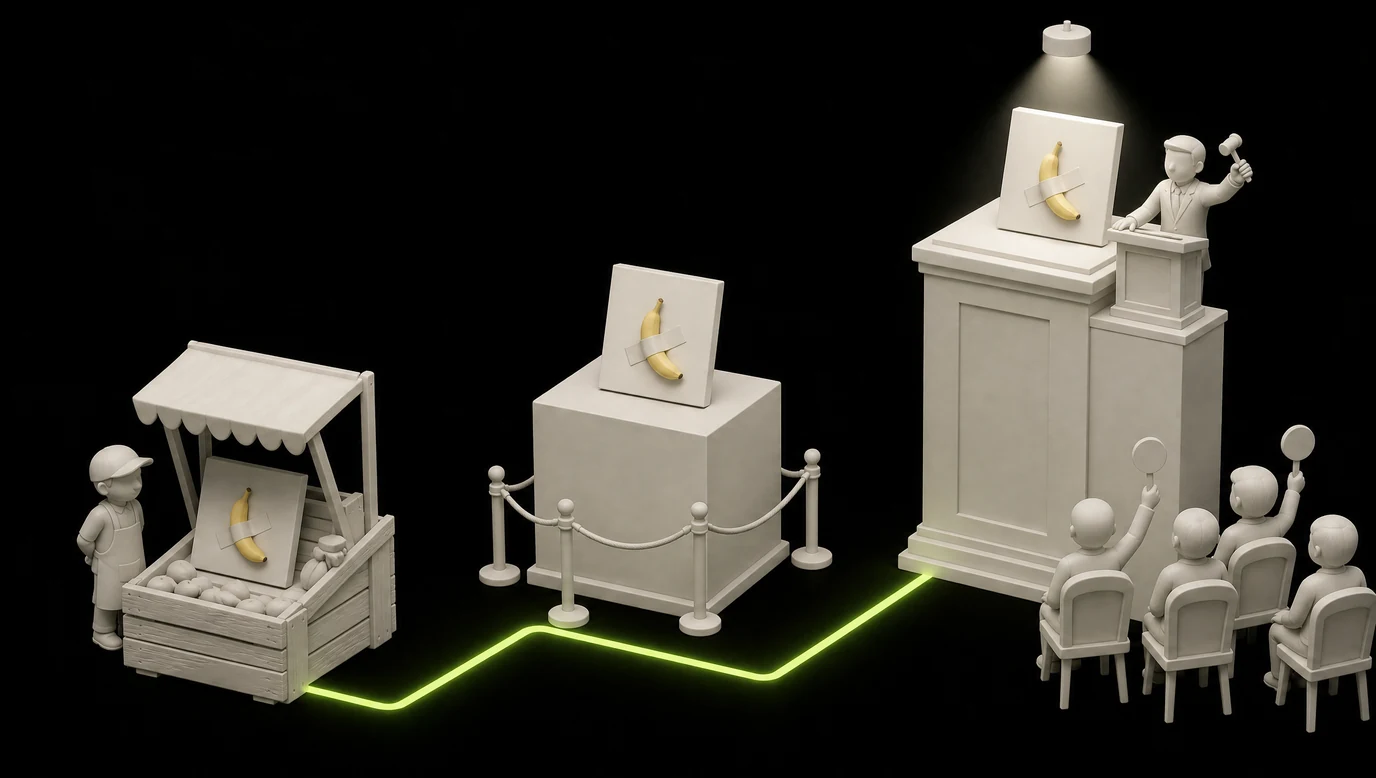
Below: five real, sourced examples of the same phenomenon, from art, advertising, music and one line of interface copy. Then a game, so you can test how well you can read a price before you read the answer.
Mini-game 1: can you read a price?
Eight real transactions. You see the work; you guess what it was paid. No trick questions — every answer is a documented number with a source. Most people who do this for a living get four or five.
If you scored badly, that is the point. Nobody reads these prices from the work. You read them from the position — and the position is invisible unless someone points at it. Which brings us to the mechanism.
Five levers that move the price of identical work
Strip the anecdotes and the same five levers keep appearing. None of them are about craft. All of them are decisions someone has to make, which is why they are the strategist's actual product.
- Attribution — who is said to have made it. Two New York dealers bought a painting at a small New Orleans sale in 2005 for under ten thousand dollars. In 2017 the same panel, re-attributed to Leonardo, sold at Christie's for $450.3 million. Not one brushstroke was added by the market. The name was.
- Frame — where it appears. In January 2007 Joshua Bell played a $3.5 million Stradivarius for 43 minutes in a Washington metro station. 1,097 people walked past, 27 gave money, seven stopped. He collected about $32. Two days earlier he had sold out a hall at roughly $100 a seat. Same violin, same hands, same repertoire.
- Scarcity — how many exist and who says so. What sold for $6.2 million at Sotheby's was not a banana. It was a certificate of authenticity and a page of installation instructions, in an edition of three. The fruit is a consumable. The position is the asset.
- Adjacency — what it stands next to. Thirty seconds of film is thirty seconds of film. Thirty seconds inside Super Bowl LX on 8 February 2026 cost an average of $8 million, with premium slots reported above $10 million, and NBC sold out before anyone knew which teams would play. The film did not get better. It got placed.
- Proof — what evidence travels with it. A user-interface team changed one button on a checkout: “Register” became “Continue”, with a line saying registration was optional. Sales rose 45 % — $15 million in the first month, $300 million in the first year. One word. The word was cheap; knowing which word, and being able to show what it did, was not.
You can object that all of this is perception, not value. That objection has been tested in a scanner, and it lost.
Here is the same principle at the scale you will actually meet it: one sentence, sold five ways. The words barely move. The price moves by three orders of magnitude.
Mini-game 2: the positioning machine
One asset. A single 30-second video, already made, already edited, sitting on a drive. Move the five levers and watch what the identical file is worth. Nothing you touch changes the film.
The uncomfortable version of that machine: two people can do identical work in the same week and bill 200× apart, and neither of them is lying. One of them decided where the work stands. The other let someone else decide.
This is also, precisely, what is happening to the job title itself. In April 2025 a listing on Reddit hired a “Jr. Creative Strategist” at $11–15 an hour — $24,000 to $31,200 a year — with three to five years of experience required and applicants restricted to Latin America. In the same period, ZipRecruiter's Los Angeles listings for the identical title ran $73,000 to $163,000. Same words on the business card. A practitioner in r/advertising named the mechanism without being asked:
“I've seen a lot of places start to use ‘creative strategist' to mean somebody who makes content calendars or graphic design. That role pays a lot less than a traditional agency strategist.”
r/advertising · 2023So when you are hiring, the title tells you nothing about the price and the price tells you nothing about the job. Both only make sense once you know what the person is actually being asked to decide. Which is section 06.
What the job actually is, hour by hour (the boring, real version)
Everything above is why the role exists. This is what the week looks like once you have it. Stripped of job-ad language, it is four repeating moves.
- Daily — read the scoreboard. Which ad is alive, which is dying, what gets killed today, what gets more budget. Recruiter 3Search puts this at roughly 20–25 % of the role's time. It is unglamorous and it is the part beginners skip.
- Weekly — mine the raw material. Reviews, DMs, sales calls, support tickets, comment sections, competitors' ads. Angles come from here. They do not come from a brainstorm, and they do not come from asking a model to “give me 20 hooks”.
- Weekly — write the briefs. Audience, angle, hook, format, reference, and what result would count as proof. The strategist's output is briefs and a test plan — not finished artwork.
- Monthly — decide what the next month is about. Which messages proved out, which are exhausted, where the money goes next. This is where most of the value is, and it is the part clients most often never see.
An agency owner writing in r/FacebookAds in May 2025 described the standard version of this and then named its weakness better than any textbook:
“The typical approach boils down to three things: voice-of-customer research, competitor ad research, and combining both to pick messaging angles to test. This foundation is solid… but it lacks a bigger-picture business planning. If every brief feels like starting from zero, it's not a strategy, it's guesswork.”
r/facebookads · agency owner · may 2025Now the part that surprises people who imagine this as an ideas job. It is a hit-rate job. Motion analysed 578,750 ad creatives across 6,015 advertiser accounts and about $1.29 billion of Meta spend between September 2025 and January 2026. The shape of the result is brutal and stable:
Read that as a job description and it stops sounding like inspiration. The work is to run enough serious attempts that a winner appears, and to recognise it early enough to put money behind it. In the same dataset, mid-tier accounts ship 6–7 new creatives a week while top spenders ship 12–19 or more — and the hit rate climbs with the volume, from roughly 4 % to roughly 9 %.
The consequence nobody puts in the job ad: a strategist without production capacity is a person writing briefs nobody can build. Strategy and production have to move at the same speed, or neither works. That is the single most common reason a smart hire produces nothing.
Mini-game 3: brief, or wish?
The brief is the physical output of this job — the thing you can actually inspect before you pay for it. Most of what gets called a brief is a wish with a deadline attached. Ten statements. Sort them.
Creative strategist vs. everyone they get confused with
Five roles, one question each. The strategist sits next to the creative director, not above or below — Indeed's own job description lists “advising the creative director” as one of the duties.
One more distinction from someone who crossed the line in the other direction, and which tells you where the scarcity really sits:
“I'm a creative director with a side passion for behavioural science. I recently started the move to creative strategist. The switch was easier to justify to my agency because it's easier to teach strategy than to teach creative thinking.”
r/advertising · 2023Taste, and the word English doesn't have for it
Everything so far is decisions. But a decision is only as good as the range of options the deciding person can actually see. That range has a name in Russian and Ukrainian — насмотренность, roughly “having-looked-at-enough-ness” — and English has no clean single word for it. “Taste” is close and misleading, because taste sounds like an opinion you hold. This is not an opinion. It is a library, and how fast you can pull from it.
The most honest description of what it feels like to have the library and not yet the ability came from a radio producer, not a marketer. Ira Glass, 2009:
“All of us who do creative work, we get into it because we have good taste. But there is this gap. For the first couple years you make stuff, and it's just not that good… but your taste, the thing that got you into the game, is still killer. And your taste is why your work disappoints you… It is only by going through a volume of work that you will close that gap.”
ira glass · this american life · 2009He had no data. Seventeen years later, 578,750 ad creatives do. The accounts shipping 12–19 pieces a week hit at roughly 9 %; the ones shipping 6–7 hit at roughly 4 %. Volume is not the enemy of quality here. Volume is the mechanism that produces it — because the gap closes by attempts, not by thinking harder about the first one.

Which leaves the practical question nobody answers: how do you actually build the library, given that everybody scrolls past ten thousand pieces of creative a week and remembers none of it? Four rules, all of them things I do rather than things I read.
- Save the decision, not the screenshot. A screenshot with no sentence attached is a souvenir. One line — “this one holds you because the payoff is withheld until 0:11” — turns it into something you can use two years later. My rule is that nothing enters the file without a sentence explaining what it is doing.
- Ask three questions of anything you save. What is it doing? To whom? What would break it? The third one is the one that teaches. If you cannot name what would make a piece fail, you have not understood why it works — you have only noticed that it does.
- Look outside your category on purpose. Your category is where every competitor has already looked, which is exactly why everything in it converges. The angles that feel new almost always arrive from somewhere adjacent — a different industry, a different medium, a different century.
- Study the survivors, not the awards. Ad libraries are public. A creative that has been running for four months is a creative that is paying for itself; one that ran for three days is a corpse. Awards tell you what the industry admires. Longevity tells you what the market pays for.
The trap on the other side: people copy the surface — the format, the transition, the font — and skip the decision underneath. That is precisely why so much AI-assisted output looks identical: the tool copies surfaces beautifully and has no opinion about who it is for. The library is not a folder of things that look good. It is a folder of reasons.
How I actually work — with this website as the worked example
I am a creative strategist, so the fair thing is to show the method on something you can inspect right now rather than on a client case you would have to take on trust. The site you are reading is the case.
My working rule comes first, because it explains everything else: find the real example before building anything. Not a moodboard — one live thing that already works, taken apart until I can name why it works. Without that step I produce the competent, forgettable average of everything I have ever seen. With it, I have something to argue against. This is the same rule as the reference library, applied at the start of a job instead of the end.
The brief I gave myself was narrow and unpleasant. Cold email to businesses is illegal in Germany without prior consent. I had no ad budget and no meaningful reach. So the site could not be a brochure that waits — it had to do the work of a salesperson who is not allowed to knock on doors.
Clay tennis on black, with a ball that behaves like a ball. A portfolio that looks like every other portfolio gets priced like every other portfolio — that is lever one from section 04, pointed at myself. Traded: instant legibility. Some visitors need a second to understand what they are looking at.
You can juggle the ball. Keep it up long enough and the reward is not a discount — it is a free audit of your marketing. Attention converted into a conversation, on the same screen, without a form standing in the way. Traded: a conventional hero section that would have converted the people who were already sold.
Every long article on this site is built on a count I ran myself: 3,053 corporate films, 2,047 recruitment videos, 1,862 explainer videos, 700 company websites, 25,693 public skill files, 160 AI answers. Opinion is free and infinite; a number nobody else has is the only thing that gets quoted — by people and by models. Traded: speed. Each of those takes days.
The German and English sides are different texts, not mirrored ones, because the vocabulary genuinely differs. In the US, “corporate design” is searched 590 times a month while “brand guidelines” gets 8,100. Translating the German page would have produced a page nobody searches for. Traded: twice the writing.
Send what you have; get an honest read within 48 hours; if it fits, there is one offer with the risk split down the middle. No three-call funnel, no deck. Traded: the upsell surface that a longer process gives you.
The receipts behind the opinions, so you can weigh them: 16 billion+ views scaled across 200+ channels, 1,500+ AI-assisted videos produced with 500M+ views, and McKinsey Forward 2026 currently in progress. Those numbers are why I am comfortable telling you which half of your marketing to stop making.
And this article is itself an example of the move it describes. Before a word was written I measured the demand: in the US, “creative strategist” is searched 1,900 times a month with an advertiser cost of $30.17 per click, “creative strategy” another 1,900, “creative strategist jobs” 1,000, “what is a creative strategist” 480 — and the whole cluster sits at a keyword difficulty between 0 and 23, which in plain English means almost nobody has bothered to answer it properly. Meanwhile the questions people put to AI assistants skew somewhere else entirely: “why is art so expensive” is asked of language models about 733 times a month. That is why this piece answers both, in one text. Deciding what should exist before making it is not a writing tactic. It is the entire job, applied to a page.

What it pays, and what it costs to hire
Two different questions, often confused. Published 2026 market data, sources at the bottom, and a warning already earned in section 05: the same title is being sold at both ends of this range.
$61,000–80,000 a year in the US, depending on whose survey you believe: Salary.com puts the average at $80,358, Payscale at $61,573 from 75 self-reported salaries. UK permanent roles run £60,000–75,000. In Germany, live job ads sit at €45,000–60,000 and the Stepstone median for marketing, media and communications is €57,250.
€814–1,088 a day in German-speaking markets — €814 for marketing consultants, €1,088 for strategy consultants on Malt; hourly around €89–94. UK contract runs £350–400 a day. This is usually the smallest sensible step for a business that is not yet advertising full-time.
$5,000–15,000 a month. Published 2026 pricing puts “basic creative strategy” inside $5,000–8,000 retainers and a dedicated strategist from $12,000–15,000. The trap: strategy is often the first line quietly dropped when the retainer gets squeezed, because it is the one deliverable nobody can photograph.
The honest comparison: €5,600 a month in-house buys one person's attention full-time. €1,000–2,000 a month of a freelancer buys their judgement part-time. Below a certain volume of advertising, the second is simply the better trade — and above it, the first becomes unavoidable.
The AI twist: production got cheap, judgement got expensive
Production costs collapsed in two years. Klarna cut its image production cycle from six weeks to seven days and took about $6 million out of image production. Unilever reports making some marketing content twice as fast at half the cost. Coca-Cola's 2025 holiday campaign was assembled by five AI specialists refining more than 70,000 clips in 30 days. By January 2026, 83 % of US ad executives said their company had deployed AI in the creative process, up from 60 % two years earlier.
Follow that through. When fifty videos cost roughly what three used to cost, the bottleneck stops being production and becomes judgement: which fifty, for whom, saying what. The scarce skill moved one step upstream — into exactly the seat this article is about. It is the same reason the creative director quoted in section 08 said strategy is easier to teach than creative thinking. The teachable part got automated first.
Mini-game 4: do you actually need one?
Five questions. Answer honestly — the verdict is more useful when it tells you not to hire anyone.
The one-line version, if you skipped the game: if you can name which piece of creative brought your last five customers, you do not need one yet. If you cannot, that is the job.
Six things worth remembering
- The work and its price are two different objects. A banana went from 35 cents to $6.2 million without changing. Somebody moved the position, not the thing.
- Position is built from five levers: attribution, frame, scarcity, adjacency, proof. All five are decisions, and decisions are what you are hiring.
- The job is a hit rate, not an idea. 4–8 % of creatives ever win; half die inside a month; volume is what raises the odds, from ~4 % to ~9 %.
- The output is briefs and kill decisions, not artwork. If a candidate cannot show you three real briefs and name a loser, they have not run enough tests to have a hit rate.
- Taste is a library, not an opinion — and it is closed by attempts, which is the one thing Ira Glass and 578,750 Meta ads agree on.
- The same title costs $11 an hour or $163,000 a year. Ask what the person decides, never what they are called.
Not sure what your marketing should be saying?
Send me your site, your ads or your channel. You get an honest read within 48 hours: which message is doing the work, what I would stop making tomorrow, and the two things I would test first. Free, no call required.
get your free audit →Creative strategist, briefly explained.
What is a creative strategist?
A creative strategist decides what an ad or a piece of content should say, to whom and in what form — then proves or kills that decision with performance data. Indeed describes the role as combining the creative intuition of a marketer with the critical thinking of an analyst. The designer makes it look good, the media buyer buys the traffic, the creative strategist decides what should exist in the first place.
What does a creative strategist do day to day?
Roughly a fifth to a quarter of the time goes to daily performance monitoring — killing what is not working, scaling what is. The rest is weekly research (reviews, DMs, sales calls, competitor ads) turned into angles and briefs, plus monthly planning of what the next month is about. The output is briefs and a test plan, not finished design. For scale: mid-tier ad accounts ship 6–7 new creatives a week, top spenders 12–19 or more.
What is the difference between a creative strategist and a creative director?
The strategist owns the why and the what; the director owns how it looks. The strategist sets the rationale, writes the performance brief and reads the result; the director owns craft and visual identity. Indeed's job description lists advising the creative director as one of the strategist's duties, so the role sits next to and slightly upstream of it, not above or below.
How much does a creative strategist earn?
In the US, Salary.com puts the average at $80,358 a year and Payscale at $61,573 from 75 self-reported salaries — published estimates diverge sharply. UK permanent roles run £60,000–75,000, or £350–400 a day on contract. German job ads sit at €45,000–60,000. Be careful with the title: an April 2025 listing hired a junior creative strategist at $11–15 an hour, while US metro listings for the same title reached $163,000.
Why can the same creative work be worth $5 or $5,000,000?
Because creative work has almost no intrinsic price — it has a position, set by five levers: who is said to have made it, where it appears, how many exist, what it stands next to, and what evidence travels with it. A banana bought for $0.35 sold for $6.2 million at Sotheby's in November 2024 without being altered. A 2008 PNAS study showed that simply raising a stated price increased both reported pleasantness and measured activity in the brain region that encodes pleasure, with the same wine in the glass.
Do I need a creative strategist for my business?
You need one when you already spend money monthly and cannot explain why results move, when you have people who can make things but nobody deciding what to make, or when you are about to increase spend — scaling a bad message is the most expensive mistake in marketing. You do not when your offer is not clear yet, when your budget is small enough that you are the strategist, or when you need one thing produced once. Then hire a maker.
Do you need a degree to become a creative strategist?
No. There is no formal qualification and no professional body. Job ads ask for platform literacy and production ability instead. In practice, practitioners report two common routes: sideways from copywriting, and upwards from account management — several strategists in r/advertising note that junior strategy roles barely exist, and that most people arrive from the account side. What gets assessed is a portfolio of creative you briefed, the reasoning behind it, and what it produced.
Is AI replacing creative strategists?
So far it is doing the opposite. AI removed the cost of production — Klarna went from six weeks to seven days on images, Unilever reports twice the speed at half the cost — so the volume of possible creative exploded and judgement became the scarce part. Meanwhile 82 % of ad executives believe young consumers feel positive about AI-generated ads and only 45 % actually do. Deciding what should exist, and whether anyone will believe it coming from you, is still human work.
How do I judge a creative strategist before hiring one?
Five checks. They ask about your customer before your budget. They show briefs, not only finished work. They can name a loser — anyone who shows only winners has not run enough tests to have a hit rate. They talk about volume, because nothing is learned at two creatives a month. And they tie the work to one number you already care about, usually cost per customer rather than impressions.