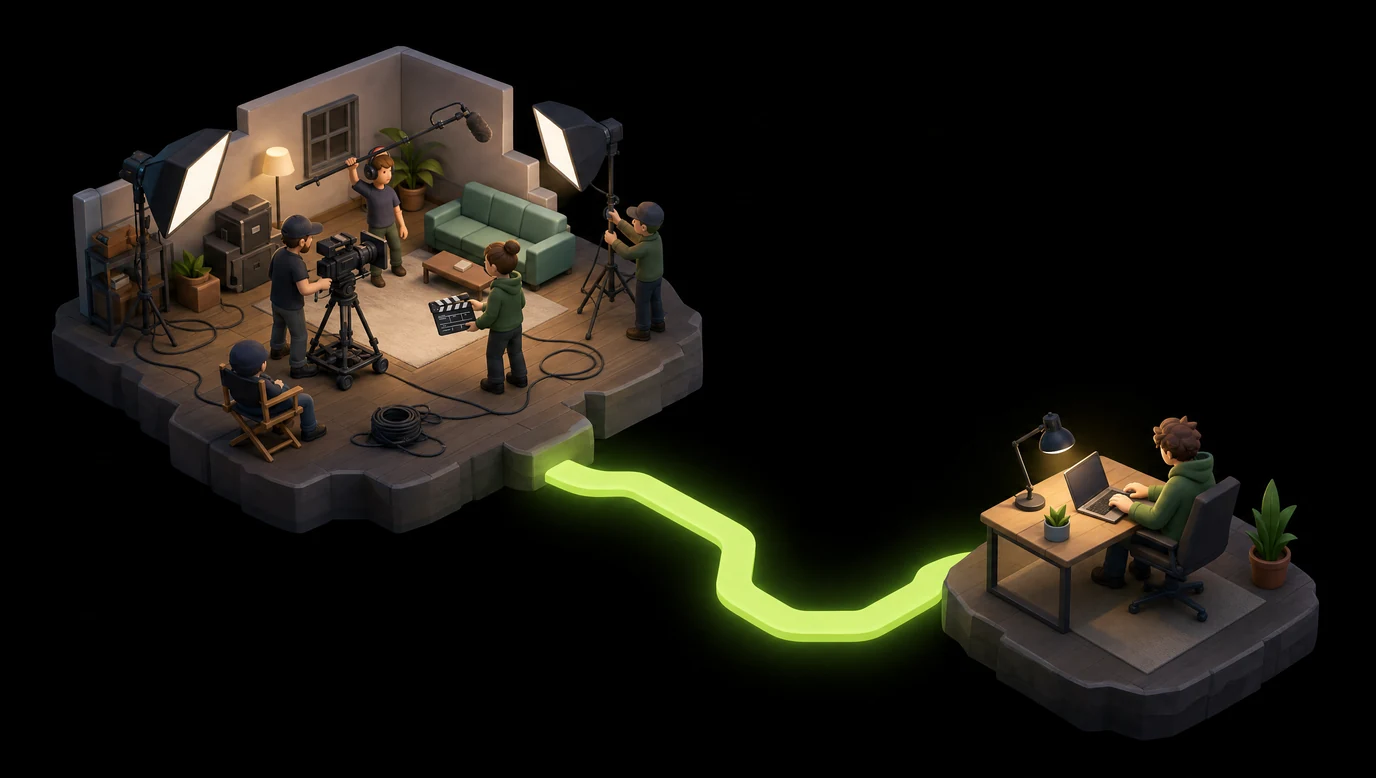
Two ways to make the same film. Two quotes. One honest table.
no theory for theory's sake
A corporate video is a film about the company itself — not about a single product, and without a direct call to buy. It answers "who are you and why should I work with you", usually runs 90 seconds to three minutes, and lives on the website, in sales meetings, at trade shows and in recruiting. In German-speaking markets the same thing is called an Imagefilm.
Its price comes from one formula: people × days × equipment. Everything else in a quote is derived from that. Once you see the formula, you can read a quote instead of believing it.
What you are actually paying for
Most quotes name a number and three words: concept, shoot, edit. That is about as useful as a car repair bill that says "car". So here is the anatomy — not so you can shoot it yourself, but so you can tell whether $18,000 is a lot or a little.
A traditional production bills for four things. Heads: director, DP, camera assistant, sound, gaffer, hair and make-up, production manager — each with a day rate. Days: every shoot day multiplies all of those rates at once, which is why the second shoot day is the most expensive line in almost any quote. Equipment and place: camera package, lighting, location fees, travel, insurance. Post: editing, colour, graphics, sound, voice-over, music and every round of revisions.
The sentence nobody says out loud: the creative part is the smallest line. The idea costs a few days of thinking. The rest is the organisation of presence — humans and machines in the same room at the same hour. That block is exactly what generative production attacks. Not the idea. The idea actually becomes more important, because it can no longer hide behind the logistics.
One more thing belongs to an honest answer: there is no current industry statistic for what a commercial costs. The only real survey — the 4A's Television Production Cost Survey — was discontinued in 2014. Its final data, from 2012, put a 30-second US spot at $354,000. Everything published since is either a production company's own price list or, more often, invented numbers recycled across content farms. If you have seen a confident "2025 production cost survey" quoted somewhere, check whether that survey exists. It does not.
Brand film, commercial, TV spot: what you are ordering
Three words that get used interchangeably in first meetings — and three completely different quotes.
Why TV commercial production was priced the way it was
A TV spot carries a second invoice most people forget: the media buy. When a national placement costs six figures, a visibly cheap film on that placement is money on fire — so production budgets were pulled upward to match. That logic, not the physics of filming, is why the numbers stayed where they were for decades. Nobody in the chain had an incentive to make production cheaper.
Corporate video production cost in 2026: the honest brackets
Corporate video production runs from roughly $5,000 for a simple social piece to over $150,000 for a multi-day campaign. The realistic middle for a mid-sized company is $10,000 to $25,000. Those brackets come from published production-company pricing, not from a survey — because, as noted, no current survey exists.
The number you actually care about is a different one: what does this money buy? Because the same budget now buys two very different things. Move the slider.
| Budget | Shot traditionally | AI hybrid |
|---|---|---|
| $5,000 | Half a shoot day, one camera, basic edit. Honestly: not a complete brand film. | A short film or a batch of social clips. Still not enough for a complete brand film. |
| $10,000 | One shoot day, small crew, standard post. No actors, no second location. | A 60–90 second main film plus first cutdowns, one voice-over, a clean edit. |
| $25,000 | A solid brand film, one or two shoot days, voice-over, grading, some graphics. | Main film, 10 cutdowns, two language versions, motion design — where most projects land. |
| $50,000 | Several shoot days, cast, multiple locations, heavy post. | A campaign package: main film, 15+ ad variants to test, three languages — or a hybrid with a real shoot exactly where it counts. |
| $100,000 | An agency-led campaign, a director with a reel, full production infrastructure. | Here the difference blurs. At this level you are buying people and judgement, not compute. |
The most important line is the last one. AI does not make everything cheaper — it changes what you are paying for. At small and mid budgets it changes a great deal, because that is where logistics dominate. At the top, where you are already paying for judgement and accountability, it changes almost nothing.
Where a $30,000 production actually goes
Let us take apart a real $30,000 quote for a two-minute film with two shoot days. Every stage separately: what happens, what it costs, and whether generative production replaces it, shrinks it or leaves it untouched.
The green bar is the part that holds the actual thinking: ten percent. Everything red and blue above it is organisation, presence and craft.
Storyboard: what a storyboard artist actually costs
A storyboard runs $500 to $3,000 depending on detail, and it has the best ratio of cost to cost-avoided in the entire process. It is a drawing of every shot before anyone touches a camera. Skip it and you make changes on the shoot day instead — where every change costs a multiple, because ten people are standing around waiting.
AI counterpart: stays, only faster — sketches become photoreal previews that double as the input for generation. → Step 3
The shoot day: the one number that governs everything
A shoot day with a small crew realistically costs $3,000 to $8,000, and considerably more with a full crew. It is not any single fee — it is that they add up and recur with every day: director, DP, camera assistant, sound, gaffer, hair and make-up, production manager, plus camera package, lighting, location, travel, catering and insurance. The union rate alone gives you the scale: $154.28 per hour for a DP in Los Angeles, a minimum of $1,234 for an eight-hour day — for one person.
AI counterpart: disappears entirely if no real people and no real place have to be on screen — and remains entirely if they do. → Section 06
Post-production: the second half of the bill
After the shoot comes the part clients underestimate most. Post typically accounts for a quarter of the total and consists of four separable crafts, often done by four different people. Important for the maths later: this block does not disappear with AI. It only changes what it is fed.
Video editing service: where the film is actually made
Editing a corporate video typically costs $1,500 to $5,000. This is the stage where footage becomes a film — rhythm, attention curve, what gets left out. A good editor rescues mediocre material; a weak one ruins good material. Revision rounds belong here too, and each additional round is another day.
AI counterpart: unchanged. Cut by humans, in the same software, in the same time. → Step 9
Color grading service: why "looking expensive" is its own line
Color grading usually costs $500 to $2,500. It is the difference between "filmed on a good camera" and "looks like a film" — mood, contrast, skin tones, matching shots recorded at different times of day. With AI material this line gains a second job: it is where clips from different generation runs are pulled into one film. Skip it and the seams show immediately.
AI counterpart: stays, and matters more. → Step 10
Motion graphics and titles
Motion design adds $500 to $4,000 — animated titles, lower thirds, figures, charts, the logo at the end. It is the line people cut first and viewers notice fastest: a well-shot film with a lifeless end card reads cheaper than it was.
AI counterpart: unchanged, still built by hand. → What a corporate design costs
Voice-over
A professional voice-over runs $300 to $1,200 depending on length, usage rights and profile. It carries far more of the effect than its share of the budget suggests — pace, warmth, authority. It is also the single most legally sensitive line once AI enters the picture.
AI counterpart: technically replaceable, legally delicate — and in some markets already covered by collective agreements. → Section 12
| Stage | Typical bracket | What AI does to it |
|---|---|---|
| Concept & script | $1,500 – 5,000 | Stays. Arguably matters more. |
| Storyboard | $500 – 3,000 | Faster, more concrete. |
| Shoot day (per day) | $3,000 – 8,000 | Disappears — or stays entirely. |
| Editing | $1,500 – 5,000 | Unchanged. |
| Color grading | $500 – 2,500 | Stays, matters more. |
| Motion graphics | $500 – 4,000 | Unchanged. |
| Voice-over | $300 – 1,200 | Replaceable, legally delicate. |
| Music & licensing | $200 – 2,000 | Replaceable, legally unsettled. |
The AI pipeline, in eleven steps
Now the same film without a shoot day. First, the biggest misconception in this whole debate: there is no button. You do not type "corporate video for an engineering firm" and receive a film. There is a chain of eleven steps in which a machine produces images and a human decides, at every step, which of them are usable. The work does not vanish — it moves from logistics into selection.
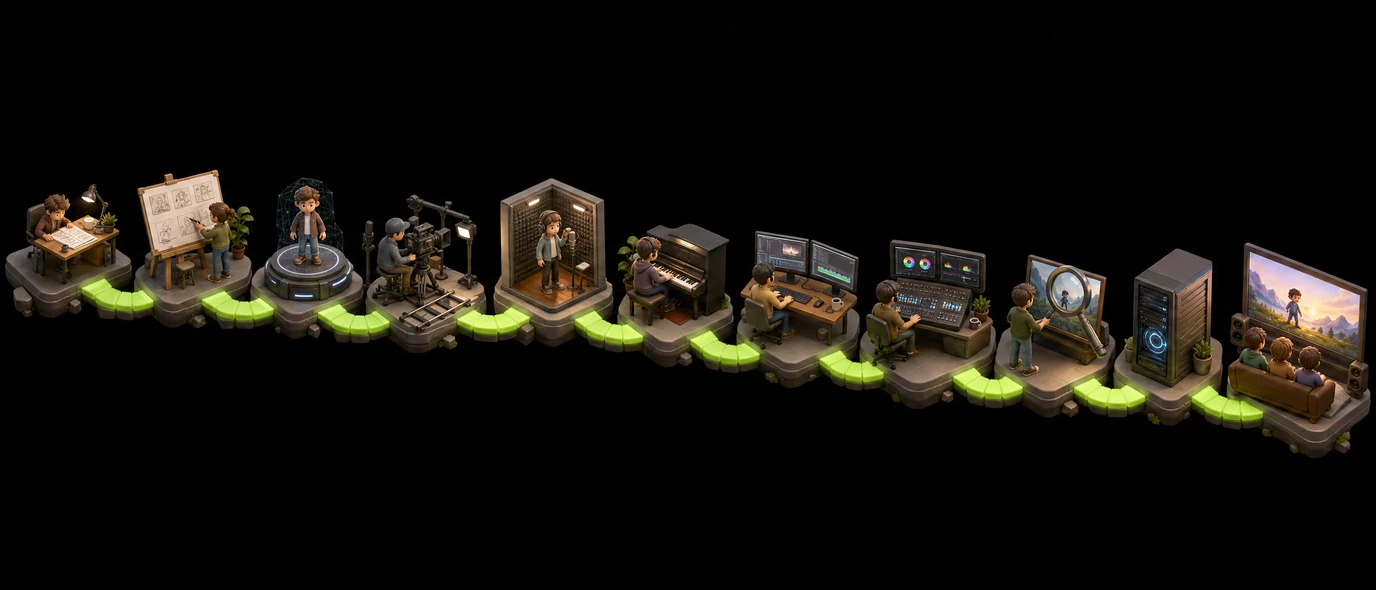
And the most honest number in this section: generation is not the bottleneck. The chief creative officer of a large American agency put it plainly at the end of 2025: "The real cost isn't generating assets, it's generating your assets — client approvals have become the new bottleneck." That matches my own experience across more than 1,500 produced AI videos exactly. The machine delivers in hours. Deciding which version wins takes days.
What AI cannot do — and where the shoot wins
If someone sells you the idea that generative production replaces everything, they are selling you something. There are six situations where I say: we shoot. Not out of nostalgia, but because the result would otherwise be worse or legally risky.
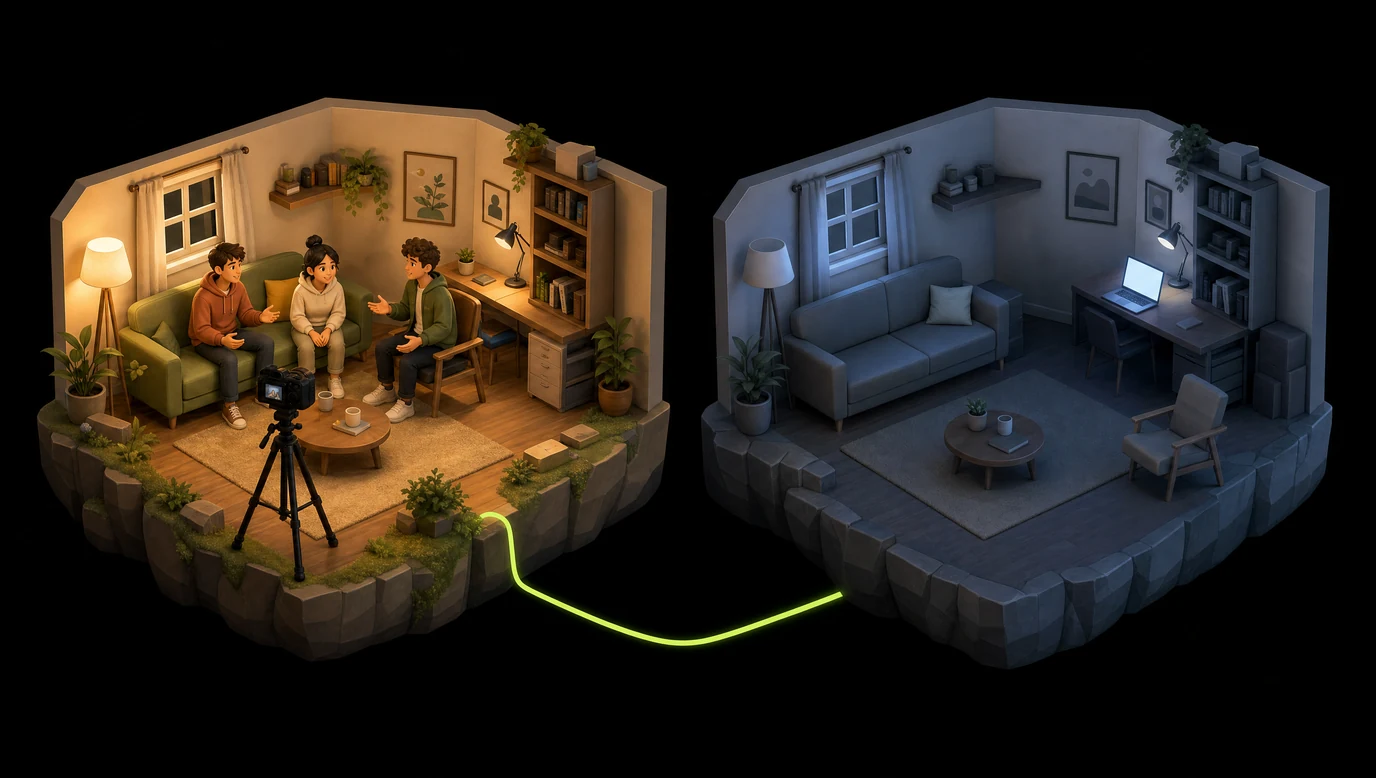
| Situation | Why | Call |
|---|---|---|
| Real people from the company | Leadership, team, staff — their credibility is exactly what a brand film is supposed to carry | Shoot |
| Testimonial video production | An invented customer is not a reference, it is a liability — and in most jurisdictions it is treated as deceptive advertising | Shoot |
| The real product in close-up | Materials, surfaces, mechanics — models invent details here. BMW named exactly this as the limit of its own AI campaign | Shoot |
| Long dialogue scenes | Over minutes, no generated figure reliably holds its face, clothing and voice at once | Hybrid |
| Events and anything live | What actually happened cannot be generated — and should not be | Shoot |
| Known faces and voices | Personality rights, union agreements, consent — trivial technically, the most expensive mistake legally | Only under contract |
There is a seventh argument that is strategic rather than technical. Audience research in Germany — one of the most AI-sceptical markets in Europe — finds the public split almost exactly down the middle on AI-generated brand advertising, while 75 % expect companies to disclose when AI was involved. That does not mean don't do it. It means "does this fit our brand?" matters as much as "is this technically possible?". For a heritage brand built on craft, a fully generated film can be the wrong signal. For a technology company it is a proof point.
Two European examples show how fast that flips. A well-known German biscuit brand launched an AI campaign in April 2025; the reaction on YouTube was blunt enough that the company pulled the film. Swiss Federal Railways did the opposite in the same year: AI image in the winter campaign, visibly labelled as AI, criticism absorbed, campaign continued. The difference was not the technology. It was the disclosure.
Formats and their prices
"Video" is a category, not a product. Here are the common formats with both invoices side by side.
| Format | Traditional | AI hybrid | Where the line runs |
|---|---|---|---|
| Corporate / brand video | $10,000 – 50,000 | $5,000 – 25,000 | Team on screen? Then hybrid. |
| Product video production | $3,000 – 15,000 | $1,500 – 7,500 | Close-ups of the real product: shoot. |
| Recruitment video | $5,000 – 20,000 | $2,500 – 10,000 | Real staff are the point: shoot. |
| Employer branding video | $8,000 – 30,000 | $4,000 – 15,000 | Generate the world, keep the people real. |
| Testimonial video | $2,000 – 8,000 | not advisable | A generated customer is not a reference. |
| Explainer video production | $4,000 – 15,000 | $2,000 – 7,500 | Ideal for AI — nothing real to film. |
| Social package (10 cutdowns) | $5,000 – 15,000 | $2,500 – 7,500 | The AI route's biggest advantage. |
| 3D animation | $10,000 – 60,000 | $5,000 – 30,000 | Technical precision: still real 3D. |
The most interesting row is the testimonial. It shows the question is never "what is cheaper" but "what is allowed to be synthetic here". A generated customer saves $6,000 and costs you your credibility.
AI commercials that already aired: examples with numbers
This is not a forecast. The following campaigns have run — on national television, in cinemas, on station billboards. I quote only what the people involved published themselves.
The numbers that matter for planning
Spectacular one-offs make poor budgets. The companies using AI for continuous production are more useful:
- Zalando reports about 90 % of editorial campaign assets generated with AI — image production down from six to eight weeks to three to four days, costs down 90 %.
- Klarna reports $10M in annualised savings across 30 AI campaigns, a quarter less spent on agencies, and an image cycle cut from six weeks to seven days.
- Unilever says AI-assisted product shoots are "twice as fast and half as expensive" — while explicitly declining to name a figure in dollars.
- One US agency documented a real campaign with 26 models across locations delivered for 26 % of the cost of a comparable live shoot.
- Across advertisers generally, one industry study measures creative production costs down 27 % — not 90 %.
And the counterpoint I consider most important: an analysis of the agency market notes drily that no commercially rational organisation cuts its own revenue base without something in return. Translated: a large share of the efficiency lands in the vendor's margin, not in your budget. Whether you benefit from AI depends less on the technology than on whether your vendor passes the saving on. Ask.
Video production company, agency, or one-person studio?
The market has sorted itself into three camps, and for most mid-sized companies the obvious choice is now the wrong one.
| Criterion | Commercial production company | Small video agency | AI video agency or solo studio |
|---|---|---|---|
| Typical budget | from $25,000 | $8,000 – 25,000 | $4,000 – 15,000 |
| Can actually shoot | ✓ full infrastructure | ✓ small crew | ± bought in |
| Variants and languages | ✗ each costs again | ✗ each costs again | ✓ marginal |
| Time to first cut | ✗ 6–10 weeks | ± 4–8 weeks | ✓ 1–3 weeks |
| Tied to a place and a date | ✗ yes | ✗ yes | ✓ no |
Do you need a production company in your city?
Only if there is an actual shoot. A traditional crew has to physically travel to you, so travel, accommodation and drive time sit in the quote — which is exactly why people search for a production company by city. A generative production has no location: briefing, approvals and delivery all happen in a browser. When a project does need real footage, buying a local crew for the day is cheaper than moving one across a country.
From one film to a testing system
The biggest gain is not "the same film, cheaper". It is structural, and most companies see it last.
A traditional $20,000 budget buys you one film. It turns out well, it sits on the website for three years, and nobody ever learns whether a different version would have worked better — because there is no different version. The same budget through a hybrid pipeline buys a main film plus cutdowns for each channel, several language versions, and a double-digit number of ad variants you can actually test against each other.
This also shifts the competence you need from a vendor. Not "who runs the shoot" but "who knows which hook, offer and audience to test next". That is a marketing question, not a production question — and the reason I sell video as part of a chain (brand, website, social, production) rather than as a standalone deliverable.
Two quotes, one decision
Configure your film and you get both quotes side by side — line by line, using the same stages as the text above. Not one number, but the difference and its cause. If your answers require real people, the right-hand column adds the shoot day back in by itself. Anything else would be dishonest.
| Line | Traditional | AI hybrid |
|---|---|---|
| Concept & script | $1,500 – 4,000 | $1,500 – 4,000 |
| Storyboard | $500 – 2,000 | $400 – 1,500 |
| Pre-production · casting, scouting, scheduling | $1,200 – 3,500 | not needed |
| Shoot day incl. crew and gear | $3,000 – 8,000 | not needed |
| Image and video generation | — | $1,200 – 3,500 |
| Editing | $1,500 – 4,000 | $900 – 2,400 |
| Color grading | $500 – 2,000 | $600 – 2,200 |
| Motion graphics | $500 – 3,000 | $400 – 2,400 |
| Voice-over, two languages | $600 – 2,400 | $300 – 1,000 |
| Music & licensing | $200 – 2,000 | $200 – 2,000 |
| Total | $9,500 – 30,900 | $5,500 – 19,000 |
How a production runs with me
- A 30-minute call. What the film has to achieve, where it runs, who decides. Then I tell you whether AI is the right tool here — including when the answer is no.
- Concept and storyboard. You see photoreal previews before anything is produced. Approval happens at that stage, not on the finished film.
- Production. Generation, selection, edit. One person decides on your side and feedback arrives bundled — that is the difference between three weeks and three months.
- Finishing. Colour, sound, graphics, a full error pass. Raw files never leave the studio.
- Handover with disclosure. You get every format plus a written breakdown of which parts were generated — which you need if the film runs in the EU.
The legal part: disclosure, faces and voices
The section most vendors skip — and the one that costs the most when it is missing.
AI advertising is legal — but since 2 August 2026, if it runs in the European Union, it often has to be labelled. That is the date Article 50 of the EU AI Act took effect. It requires whoever deploys AI-generated content to disclose that it was artificially created or manipulated.
Who this applies to
The obligation attaches to the deployer, not the model provider — that means the advertiser, the agency or the freelancer running the campaign. The trigger is content resembling existing persons, objects, places or events that could falsely be taken as authentic; intent to deceive is explicitly not required. Penalties reach €15 million or 3 % of worldwide annual turnover, whichever is higher. And in Germany there is a faster route than regulators: competitors and trade associations can send cease-and-desist letters under unfair-competition law as soon as a labelling duty counts as a market-conduct rule.
Honestly, because I am not selling fear: as of this writing no company has been fined or formally warned over unlabelled AI advertising. The duty is days old. But the enforcement infrastructure is fully assembled, including a dedicated complaints form at Germany's central unfair-competition body. This is a live risk, not a pile of precedent.
In the United States the movement is on the performer side: New York's synthetic performer disclosure law took effect on 9 June 2026, with penalties of $1,000 to $5,000 per violation. Agencies there are already building a disclosure step into the concept phase rather than the delivery phase.
Can I recreate a real person's face or voice?
Only with explicit consent. In Germany, § 22 KunstUrhG requires the consent of the depicted person, and protection lasts ten years beyond death — the Federal Court of Justice established in its 1999 Marlene Dietrich ruling that commercially exploitable elements of personality are inheritable and protected. Since February 2025 there is also a collective agreement covering generative AI for performers, requiring consent and compensation before a digital replica is used. In the US, the equivalent friction comes from union positions and state-level publicity rights. The practical rule is identical everywhere: no signature, no face, no voice.
Who owns an AI-generated commercial?
Under German copyright law, only personal intellectual creations are protected works. Pure machine output without human creative contribution is not protected; what is protected is the human share — selection, arrangement, editing, composition. Where exactly the threshold sits is unsettled. The practical consequence for you as a client: get the rights assigned in writing and ask which tools were used, because vendor terms differ substantially in what they grant and what they indemnify. The long version of this question sits in the AI video production piece.
- A film's price is people × days × equipment. The shoot day is the most expensive line — and the only one that can genuinely disappear.
- Concept, editing, colour and graphics stay. AI replaces the shoot, not post-production.
- Realistic generation yield: about 15 usable clips from 400 attempts. Anyone promising one-click has not done it.
- Real people, real customers, the real product in close-up: shoot. Everything else is negotiable.
- If the film runs in the EU, disclosure has been mandatory since 2 August 2026. Get it in writing at handover.
Short answers, no marketing
How much does corporate video production cost?
Between roughly $5,000 for a simple social piece and over $150,000 for a multi-day campaign. The realistic middle for a mid-sized company is $10,000 to $25,000. With an AI-assisted pipeline the same scope moves down, because the shoot day disappears — provided no real people need to be on screen.
How much does a 3-minute corporate video cost?
Shot traditionally, usually $15,000 to $50,000, because three minutes normally means several shoot days, several setups and considerably more editing time. Length itself is not the cost driver — the number of shoot days is. A three-minute film from a single shoot day can cost less than an elaborate 60-second one.
How long does corporate video production take?
Traditionally six to ten weeks from concept to final master; with an AI pipeline one to three weeks. Both are extended by the same two things: too many decision-makers and late feedback. On length: a corporate video should run 90 seconds to at most three minutes.
What is the difference between a brand film and a commercial?
A brand film says who you are; a commercial says why someone should buy. The brand film builds trust and lasts years, the commercial targets a specific offer and ages faster. A TV spot is the carrier format for paid placement — 15 or 30 seconds.
How much does TV commercial production cost?
The last measured industry average for a 30-second US spot was $354,000, from 2012 data — the survey was discontinued in 2014 and has no credible successor. Today's practitioner ranges run from roughly $25,000 for a regional spot to several hundred thousand for a national one. Remember that the media buy is a second, often larger invoice.
How much does a shoot day cost?
Realistically $3,000 to $8,000 with a small crew, considerably more with a full one. The figure is an addition: director, DP, assistant, sound, gaffer, hair and make-up, production manager, plus camera package, location, travel and insurance. For scale, the union minimum for a DP in Los Angeles alone is $1,234 per eight-hour day.
What does a video editing service cost?
For a corporate video, typically $1,500 to $5,000, including revision rounds. Editing is where the film is actually made — rhythm, structure and what gets left out — and it is the one post stage that AI production does not change at all.
How much does explainer video production cost?
Traditionally $4,000 to $15,000; with AI production $1,500 to $6,000. Explainers suit generative production particularly well because there is nothing real to film — the job is illustrating an idea, not documenting something that exists.
Is AI-generated advertising legal?
Yes. But if it runs in the European Union, Article 50 of the EU AI Act has applied since 2 August 2026: content resembling existing people, objects or places that could be taken as authentic must be disclosed as artificially generated. Penalties reach €15 million or 3 % of worldwide turnover. In the US, New York's synthetic performer disclosure law took effect on 9 June 2026.
Do AI ads have to be labelled?
In the EU, in many cases yes. The test is whether the content could falsely be perceived as authentic. A photoreal person in a product ad is disclosable; an obviously surreal or cartoon depiction generally is not. The duty falls on whoever deploys the AI — including freelancers and marketing service providers, not just the model's maker.
How do I get an AI commercial made?
The sequence mirrors a traditional production minus the shoot day: concept, script, storyboard with photoreal previews, approval, image and video generation, voice-over, music, edit, grade, master. What decides quality is that a human filters at every step — the usable yield is a few percent.
Can AI replace actors?
Technically often yes, practically only within limits. Over longer dialogue scenes, consistency of face, clothing and voice remains unreliable. And where the credibility of real people is the entire point — leadership, staff, customer testimonials — a generated figure does not replace the statement, it destroys it.
Can I clone a real face or voice for an ad?
Only with explicit, documented consent. In Germany § 22 KunstUrhG governs the right to one's own image, with protection extending ten years past death; voice is protected through general personality rights. Since February 2025 a collective agreement additionally requires consent and compensation for digital replicas of performers.
Who owns an AI-generated commercial?
Under German law only personal intellectual creations enjoy copyright, so pure machine output without human contribution is unprotected; the human share in selection, editing and composition is. As a client, have the rights assigned contractually and ask which tools were used — their terms differ substantially.
How fast can an AI commercial be produced?
One to three weeks from concept to master is realistic, and a few days for something small. The limiting factor is almost never generation — it is the number of approval rounds on the client side. Bundled feedback within 24 hours roughly halves the timeline.
Do I need a video production company in my city?
Only if there is an actual shoot. A traditional crew has to travel to you, which is why travel and accommodation appear in the quote. A generative production has no location — briefing, approvals and delivery all happen remotely. When real footage is needed, hiring a local crew for the day beats moving one across the country.
You have a quote on your desk. I will tell you honestly whether it holds up.
Send me what you are planning — or the quote you received. I will look at which lines are realistic, which are missing, and whether AI is the right tool for your case at all. If it isn't, I will say so. Free, no call required first, no obligation after.
Request a free audit →As of August 2026. Prices are market brackets for orientation, not offers: traditional ranges come from published production-company pricing and the last measured industry survey, AI ranges and timings from my own production costing and are marked as such. This text is not legal advice. The cover and illustrations were generated with AI; every diagram in this piece is a hand-built HTML graphic.
- EU AI Act, Article 50 — transparency obligations
- European Commission — FAQ on the transparency obligations
- MediaPost — the 4A's production cost survey and its discontinuation
- IATSE commercial production rates
- Ad Age — the AI spot that aired during the NBA Finals
- NPR — reach and reaction to the same spot
- Tool of North America — production report, Under Armour
- BMW — generative AI campaign for the iX3
- Digiday — documented cost comparison from an agency
- § 22 KunstUrhG — the right to one's own image