The audience is not refusing to watch. It is refusing to shut up.
own measurement, 22 august 2026 · method disclosed · every raw count in the piece
An "AI ad" is not one thing, and the whole argument gets confused because of it. There are three different objects wearing the same name: a film whose frames were generated by a video model; a film shot conventionally where AI did grading, cleanup, upscaling or a style pass; and a film that features an AI-generated person. Audiences punish the first and the third. They have never once punished the second — and I have the same brand doing both, four years apart, to prove it.
Everything below is about the first kind: generated footage passed off as the finished advertisement. That is what Coca-Cola released in 2024 and again in 2025, what Kalshi ran during the NBA Finals, and what Svedka ran at Super Bowl LX. It is also the kind that carries a legal disclosure duty in the European Union since 2 August 2026, and a union price tag in the United States that is higher than hiring the human.
If you only take one line: AI is safe wherever the audience is not looking at a face, and expensive wherever it is. The rest of this piece is the evidence for that sentence, in numbers I pulled myself.
How I measured it
Views are a broken instrument for this question. A brand ad on YouTube is usually a paid placement: the view count is bought, not earned, so an ad with a hundred million views may have been watched attentively by almost nobody. Comparing view counts between a promoted spot and an organic one tells you about the media budget, not the work.
So I used a ratio where both halves come from the same population — people who actually watched and then did something: comments per 1,000 likes. A like is the cheapest possible approval. A comment costs effort. When the ratio between them jumps, it means the film is producing something other than approval. I have been calling it the argument ratio.
The corpus is every AI-made brand advertisement I could verify as a real campaign — not spec work, not an agency's showreel, not a tutorial. That distinction matters more than it sounds: most of what ranks for "best AI commercials" is unpaid spec work made by creators using a famous brand's name without the brand's involvement. Those are not advertisements. They are portfolios.
That left eight verified films across three brands, of which seven had comments enabled and could be measured. Against them I set sixteen conventional advertisements from the same official Coca-Cola channel, spanning 2013 to 2026, so the comparison is one brand's own audience judging one brand's own output — not a comparison between different audiences.
559 against 51.5
Coca-Cola's ordinary advertisements have run at a remarkably stable rate of argument for over a decade. Masterpiece in 2023: 24 comments per 1,000 likes. Small World Machines in 2013: 72. For Everyone in 2025: 51. Across sixteen conventional films the median is 51.5, and the whole range sits between 24 and 102.
The AI films do not sit anywhere near that range. The lowest of them, the 2024 Silver Santa, is at 378 — nearly four times worse than the worst conventional ad in the set. The 2025 Holidays Are Coming is at 726. Its ninety-second sibling is at 1,112, which is twenty-two times the brand's own median.
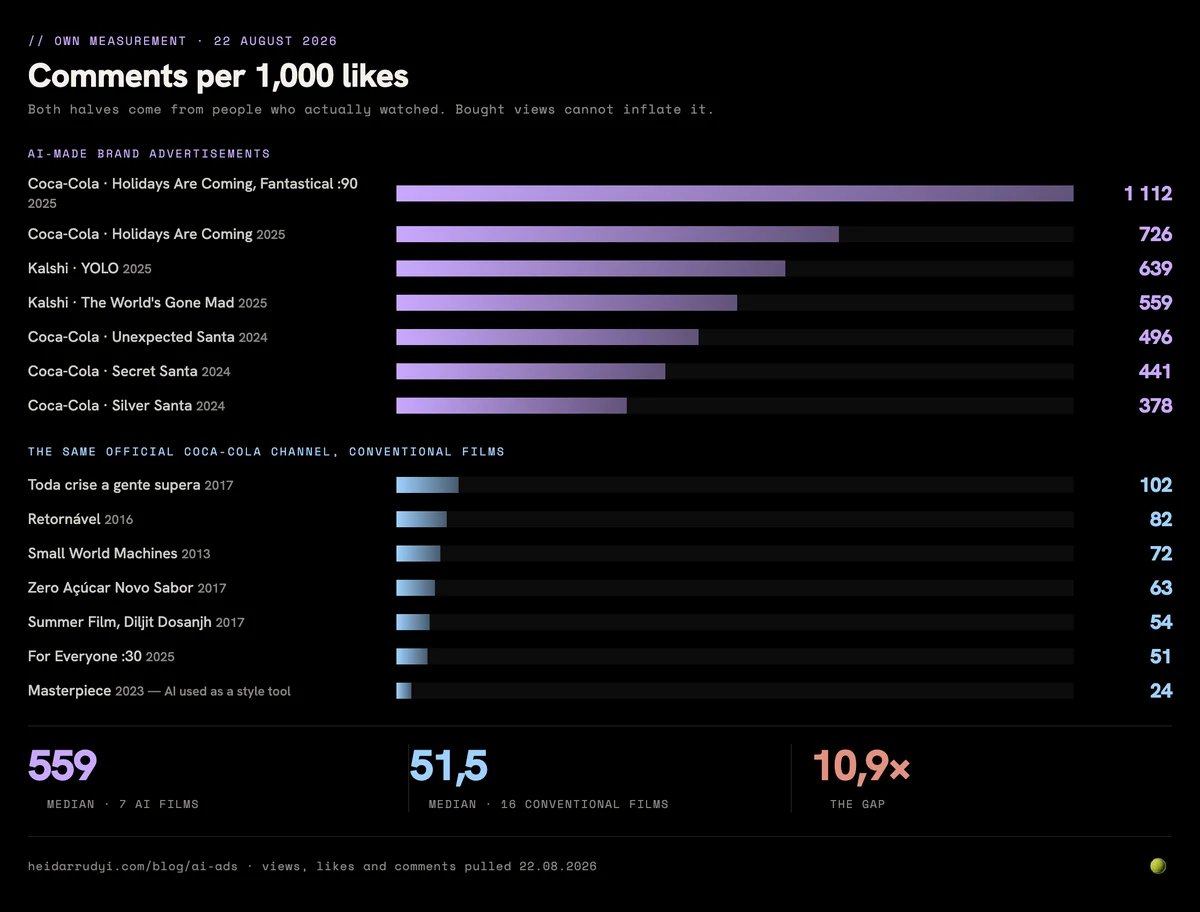
A conventional advertisement is watched and, overwhelmingly, not discussed. That is what an advertisement is supposed to do. The AI films are not being watched and ignored — they are being watched and answered. And the answer is not the one the brand wanted, which is the next section.
It is not outrage-farming. Coca-Cola did not buy engagement. It bought a film whose most-liked response is a joke about its competitor, and then paid to put that film in front of 2.8 million people.
The eight films — go and check every number yourself
A study you cannot audit is an opinion with a chart on it. So here is the whole corpus with the counts as I recorded them on 22 August 2026, each one linked to the upload it came from. Numbers move — that is what live pages do — so treat these as a snapshot with a date on it, and if yours differ, the direction is what matters, not the decimal.
I read the hundred loudest comments. None of them was praise.
The 2025 Holidays Are Coming spot carries 12,117 comments. I took the top hundred in YouTube's own relevance order — which is roughly the hundred the platform decided most people should see — and classified every one of them by hand.
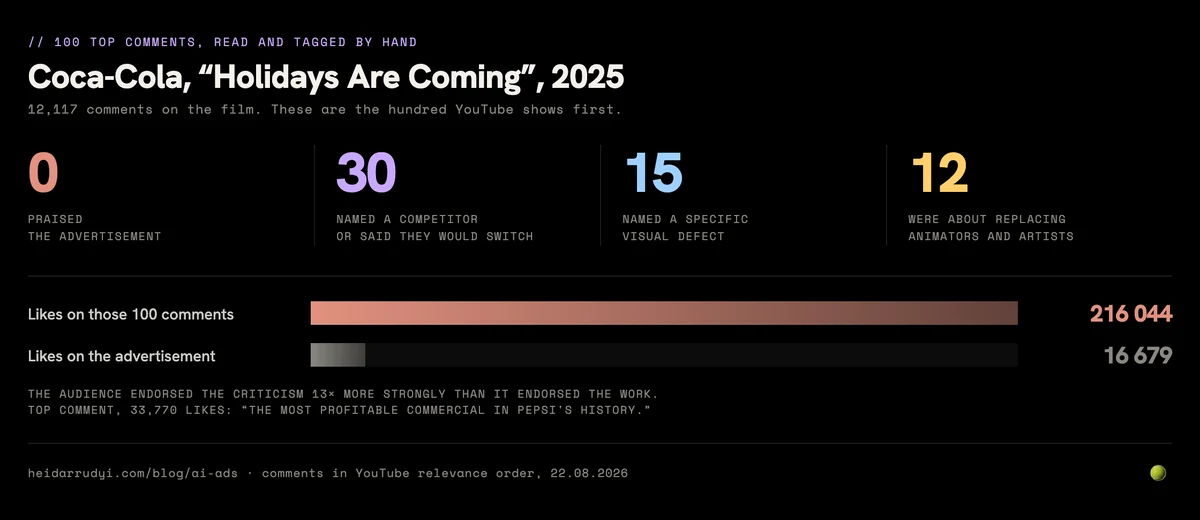
Zero praised the film. That is not a rhetorical flourish, it is the count: I could not find a single comment in the hundred that said the advertisement was good. The nearest thing to approval was a comment approving of the other comments.
Thirty of the hundred named a competitor or announced a switch. Twenty-seven of them named Pepsi specifically. The most-liked comment on Coca-Cola's own advertisement, with 33,770 likes — more than twice the likes on the film — reads:
"The most profitable commercial in Pepsi's history."
Behind it, in order of likes: "I really miss pre-AI internet" (20,352). "Nothing says christmas quite like 'dad got fired because AI replaced him to do animation.'" (19,189). "just because you can, doesn't mean you should" (10,747). "We must thank Cocacola for leaving the comments open" (8,085). "The unintended irony of using 'Real Magic' as the tagline is hilarious" (7,419). "Remember when they paid real animators to make commercials with heart. Now it's soulless AI." (6,406).
Add the hundred up and they carry 216,044 likes. The advertisement carries 16,679. The audience endorsed the criticism thirteen times more strongly than it endorsed the work. That is the finding I would put in front of a board, because it converts a vibe into a ratio: a brand paid for media, and the media delivered an audience to somebody else's punchline.
Twelve of the hundred were not about aesthetics at all. They were about employment — animators, artists, the people who used to make this film. This is the part brands consistently misread as a technology objection. It is a moral objection, and moral objections do not get solved by a better model next year.
The same brand made the opposite ad, and the same audience did the opposite thing
In 2023 Coca-Cola released Masterpiece: a boy in a gallery, artworks coming alive to pass a bottle down to him, Vermeer's Girl with a Pearl Earring at the end. It was made by a production company, a VFX house, a director, a DOP and an editor — and it used AI too, for style transfer on the painted frames. Nobody minded. Its argument ratio is 24, the lowest in the entire control set.
Reading its top hundred comments after reading the other film's is disorienting. They are lists of the artworks with timestamps. They are "hats off to all the VFX houses who worked on this". They are "genuinely an ad I would not skip". And there is exactly one comment about a competitor, running in the opposite direction:
"I loooove this commercial! I normally drink Pepsi, but this commercial makes me want to go out and buy Coke."
Same brand. Same channel. Same product. One film moved a Pepsi drinker toward Coke. The other moved thirty out of a hundred people toward Pepsi. The variable is not "AI was involved" — AI was involved in both. The variable is whether a human authored the thing the audience is looking at.
The audience worked this out on its own, unprompted, and stated it more precisely than most industry commentary has. Under Masterpiece, two years after it ran:
"It wasn't made by AI. It was made by humans using AI. So I can feel the feelings of the person who made this ad."
"The difference between this and the recent ad is this has purpose and direction, with a clear passion behind it. The AI was simply a tool in the repertoire of artists alongside conventional methods to help the process along. The newest commercials have no substance."
If you are a marketing director looking for the operating rule, it is in that second comment and it is free: the audience does not object to the tool. It objects to being handed the output of the tool as though it were the work.
Half the brands switched the comments off
Of the four AI advertisements I found on official brand channels, two have comments disabled: the Toys"R"Us Sora film from 2024 and Svedka's Super Bowl LX spot from February 2026. Both were, at the time, the loudest AI-advertising story in the world. Both arrived on their own channel with the reply function removed.
Coca-Cola left them open. Twice. And under the 2025 film, two separate comments thanking them for it collected 9,658 likes between them — including "Very bold to leave comments on" at 1,573.
There is a straightforward read here that I think is the correct one. A company that expects applause does not remove the applause box. Disabling comments on the launch of your flagship campaign is a pre-registered prediction of the reaction, made by the people with the most information about the work. If your agency proposes an AI campaign and simultaneously proposes turning off comments, they have already told you the answer.
Four months. For thirty seconds.
The reason a marketing director signs off on generated footage is almost never that they think it will look better. It is the two numbers in the pitch deck: faster and cheaper. Both of those numbers come from press coverage rather than from production, and the people who did the production have been unusually candid about it.
Svedka ran the first primarily AI-generated national Super Bowl spot in February 2026. Ad Age's editor-in-chief Jeanine Poggi, relaying what Svedka's own CMO told her, put it like this: they "spent more time working on this ad, even with it being made with AI, than they have on any piece of creative in their career". TechCrunch reported the specific figure: roughly four months to rebuild the brand's robot character and train the system to hold its facial expressions and body movement across shots.
Coca-Cola's 2025 sixty-second film ran on a similar arithmetic in the other direction: not a long schedule but an enormous throughput. The studio's own behind-the-scenes account, reported across the trade press, puts it at more than 70,000 generated video clips in 30 days. Secret Level's founder Jason Zada framed the headcount as about twenty people against roughly fifty for a conventional version; other reporting on the same production describes over a hundred people touching frames. Both of those can be true — a small core team and a large hand-finishing tail is exactly what this workflow produces.
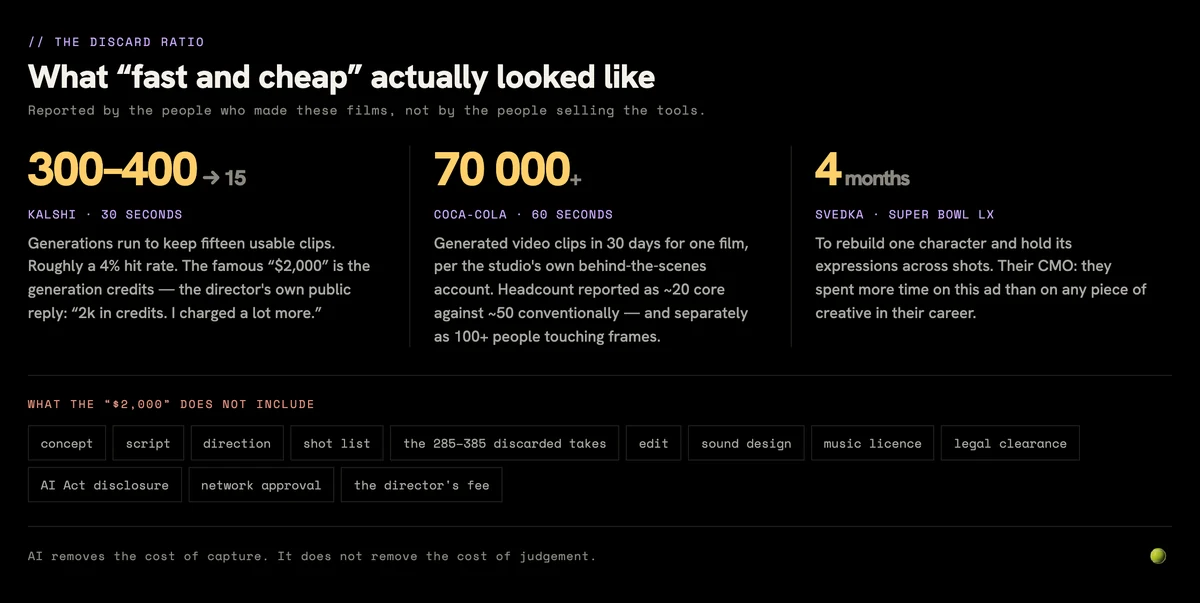
Generative video is not a shortcut through production. It is a different shape of production: the shooting day disappears and reappears as a selection problem, spread across weeks, with a hit rate low enough that most of the labour is now watching bad takes. Anyone who has graded 1,500 AI videos, as I have, recognises the shape immediately. The camera crew is gone. The edit suite has quadrupled.
The $2,000 advertisement was never $2,000
In June 2025 the prediction market Kalshi ran a spot during Game 3 of the NBA Finals, made with Veo 3 by the director PJ Accetturo in about two days. Every listicle written since has repeated the same figure: it cost $2,000. It became the founding fact of the whole "AI killed the ad budget" story.
Under his own upload of that ad, a viewer asked the obvious question. He answered it in public, and the reply is still there:
— "Did it cost you 2K or did you charge the client 2K?"
— "2k in credits. I charged a lot more."
So $2,000 is the GPU bill. It is the cost of the raw material, quoted as though it were the cost of the finished good — the equivalent of saying a commercial cost the price of the film stock. What the number does not contain: the concept, the script, the shot list, the direction, the 300 to 400 generations run to keep fifteen clips, the edit, the sound design, the music licence, the legal clearance, the platform disclosure, the network approval, and the fee of a director with fifteen years of experience — which is the only reason the thing was watchable.
Strip that fee out and you get the version of this that floods the internet, where the $2,000 really is the whole budget, and it looks exactly like what it cost. That is the honest version of the promise: AI removes the cost of capture, not the cost of judgement. The judgement is what you were paying for.
In a US union commercial, the AI actor costs more than the human
The search volume tells you where the interest actually is. In the United States, "ai actress" is searched 22,200 times a month, "ai casting" 12,100, "ai actors" 5,400, "ai influencer" 60,500 — a bigger cluster than "ai ads" and "ai commercials" combined. Everyone wants to know whether the person on screen still has to be a person.
For a US union commercial the answer has a price attached, and the wording is public. The 2025 Commercials Contracts separate two things the debate constantly merges: a digital replica is a real performer recreated, and a synthetic performer is somebody who never existed. For the second, the advertisers' own bargaining body states the clause plainly — where a synthetic performer appears in a commercial that also contains “the on-camera principal performance of at least one (1) human”, the producer shall, within thirty days of the first air date, “pay 1.5 session fees and contributions … based upon the 1.5 session fees and, where applicable … scale use and holding fees that would have been due to a human performer rendering the performance.” Where a commercial uses synthetic performers only, the amount is negotiated with the union case by case.
The contract does not merely permit synthetic performers. It prices them above the humans they replace — and the money does not go to a performer, because there is not one. It goes into the Pension and Health Plans: the fund that pays for the pensions and healthcare of the people who were not hired. Where a real person is recreated instead, the rules are stricter still: forty-eight hours' notice before services, written consent through a rider, and the performer paid as if they had performed in person, including holding and use fees at scale.
Layer the statutes on top. New York's synthetic-performer law, signed in December 2025, requires content featuring AI renders that look like real people to be conspicuously labelled. From July 2026 Amazon began requiring third-party sellers to label photos and videos featuring AI-generated people. SAG-AFTRA's June 2026 TV/Theatrical agreement goes further still: synthetics may be deployed only where they deliver value a living performer could not.
Put the three together and the synthetic-actor business case inverts. You do not save the talent fee — you pay 1.5× of it. You do not skip the paperwork — you add consent documentation and a label. You do not shorten the schedule — Svedka spent four months on a character. What is left is not cheaper, faster or simpler. It is only synthetic.
Viewers do not notice hands. They notice continuity.
Fifteen of the hundred comments named a specific visual defect. Not one of them mentioned fingers, and not one mentioned eyes — the two tells that every detection article on the internet is built around. Here is what people actually named, in their own words:
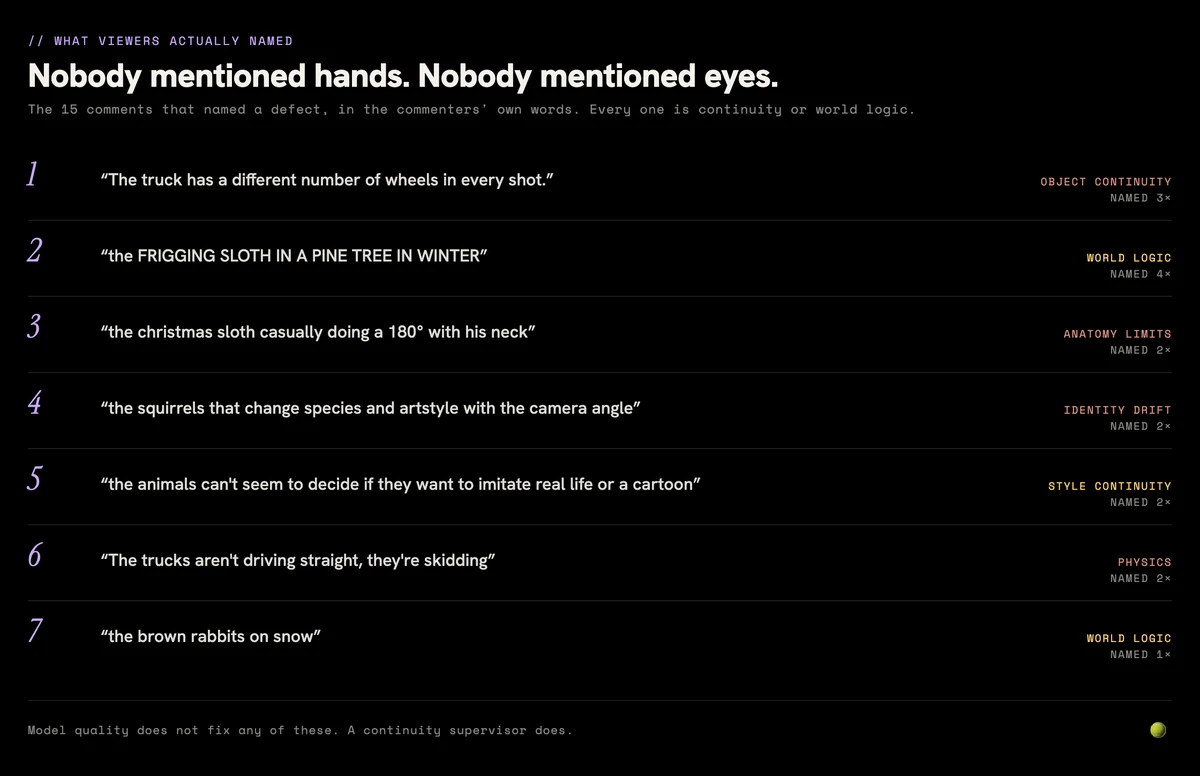
Read the list again and notice what kind of error it is. "The truck has a different number of wheels in every shot." "The trucks aren't driving straight, they're skidding." "My favorite part is how the animals can't seem to decide if they want to imitate real life or a cartoon." "the christmas sloth casually doing a 180° with his neck." "the squirrels that change species and artstyle with the camera angle." "the brown rabbits on snow." "the FRIGGING SLOTH IN A PINE TREE IN WINTER."
None of that is a rendering problem. The pixels are excellent. Every single one is a failure of continuity between shots or of world logic inside a shot — an object that does not stay the same object, an animal that does not live where the film put it. Those are precisely the two things a director, a continuity supervisor and an art director exist to prevent, and precisely the two things a prompt cannot hold, because each generation is an independent event with no memory of the last one.
Which gives you the practical version. Model quality will not fix this. Better models make prettier independent events. What fixes it is the role that was removed to save money: someone whose entire job is to make shot 7 agree with shot 3. If you are commissioning AI video, that is the line item to protect — and it is the one every quote you receive will have quietly deleted.
The six-shot continuity check
- Count the wheels, doors and windows across every shot.
- Confirm each animal, plant and location is possible in the season and climate shown.
- Watch once at 0.25× for anatomy that rotates past its limit.
- Check that light direction and time of day survive the cut.
- Confirm the product itself — label, shape, colour — is identical in every frame.
- Hand it to one person who has not seen it and ask what looks wrong.
It is worse in print and social, because there is no motion to hide behind
Everything above is video, where the eye is moving and a defect lives for four frames. The fashion and retail brands ran the same experiment on still imagery, where the audience can stare — and the results were faster and more brutal.
- Skechers ran a full-page spread in Vogue's December issue. A creator on TikTok pulled it apart: faceless figures in the background, garbled text on a store awning, a chunk missing out of a dress. Fortune's headline was a consumer's own sentence — "you actually didn't save any money because now I hate you." Ads in the same style reappeared across the New York subway in April 2026.
- J.Crew was caught by the newsletter Blackbird Spyplane over an Instagram campaign: a foot bending backwards, props that do not resolve. The brand credited an AI artist, without clarifying whether the models were synthetic. The sharpest criticism was not about the technology — commenters accused it of chasing novelty rather than drawing on its own rich archives, which for a heritage label is the more expensive charge.
- Shein had to pull a product listing whose generated image carried a likeness resembling a real, notorious individual, with the usual finger and texture flaws, and promised stricter monitoring of vendor designs.
Two things generalise from this. First, the discovery is crowdsourced and it is fast — in every case the defect was found by a reader with a phone, not by a journalist, and the brand learned about its own campaign from the internet. Second, the damage lands hardest exactly where brand equity is built on heritage and craft. A prediction market can absorb a chaotic AI spot; it is arguably on-brand. A clothing label whose entire proposition is taste cannot, because the medium is the message: an audience that catches you generating the picture concludes something about how you make the product.
"You actually didn't save any money because now I hate you."
"Why is every commercial AI now?" — they aren't. Not remotely.
Google's own "people also ask" box for this subject carries the question "Why are all commercials AI now?" It is worth answering with the number instead of a mood, and the cleanest test available is the Super Bowl, because every national spot is public, documented and expensive enough that nobody runs one by accident.
At Super Bowl LX in February 2026, at roughly $8 million for thirty seconds, the count of fully AI-generated national spots was two: Svedka and Artlist. Everything else on the roster that got filed under "AI ads" was a conventional commercial about an AI product — Meta's glasses, Google's image model, Amazon's Alexa+, Ring's feature, Anthropic's spot arguing against advertising inside chatbots. Those are ads for AI. They are not ads made by AI, and the category has been quietly collapsing the two for two years.
So the perception of saturation is real but misplaced. What has saturated is not television — it is the feed: social-tier performance creative, marketplace listings, programmatic connected-TV inventory, and the endless spec reels of famous brands that never commissioned them. The flagship film, the thing a brand is judged on, is still overwhelmingly shot. The two brands that broke that rule at the highest level are the two whose comment sections are switched off.
Adoption is not uniform. It is inversely proportional to how much the brand has to lose in that frame. AI has taken the work where nobody was watching closely — and stalled hard at the work where everybody is.
"Made by humans" is now a claim brands put on the packaging
The most commercially interesting consequence of all this is not that AI ads underperform. It is that the opposite of an AI ad has become a sellable proposition — and unusually fast.
- Aerie pledged "No AI-generated bodies or people. Real people only." Reported as the brand's most-engaged post of the year: 40,000+ likes and 500+ comments.
- Apple TV's Pluribus, from Vince Gilligan, put "This show was made by humans" into its end credits.
- iHeartMedia launched a "guaranteed human" campaign — no AI personalities, no AI music — citing research that 90% of its listeners, including people who use AI tools themselves, want their media made by real people.
- Le Creuset captioned a collaboration "created entirely by hand using digital art and real video footage, not AI."
- Equinox and Almond Breeze ran campaigns naming AI slop directly. Several Super Bowl LX advertisers briefed teasers specifically on keeping AI out of the creative process.
Note what these brands are doing structurally. They are not making a technology argument. They are converting a production decision into a brand attribute — the same move organic food made with "no additives", and the same move Swiss watchmaking made against quartz. Once a cheaper method becomes universally available, doing it the expensive way stops being a cost and becomes a signal. Handmade is only a premium after the machine exists.
Which produces the strategic question every marketing director should be asked this quarter, and almost none are: if your competitor announces next month that their advertising is guaranteed human, what is your answer? There are only two, and "we don't talk about it" stops working the moment somebody in your category does.
The surveys agree with the comment sections
A comment section is a self-selecting, argumentative and unrepresentative sample, and I would not publish it alone. So here is the independent instrument pointing the same way: a June 2026 study run by The Harris Poll with the 4A's and Infillion, presented at Cannes Lions and titled — with some feeling — "I Never Asked for This."
- 78% of consumers say AI makes ads "feel less authentic".
- 73% say they are less likely to trust an ad they suspect was made with AI.
- 63% say they are less likely to purchase from a brand that uses AI-generated ads.
- More than two-thirds see AI in marketing as largely a "marketing ploy", and the same share find brands "cringey" when they overuse it.
Two instruments, two completely different methods, one direction. The comment data tells you the reaction is intense; the survey data tells you it is broad. Neither on its own would be enough. Together they describe a cost that does not appear anywhere on the production estimate: a discount applied to the message because of how the message was made.
And a warning against over-reading. None of this says the ads did not sell anything. Coca-Cola is one of the most distributed products on earth, and a bad Christmas film will not move its volume in a measurable way — which is exactly why a company that size can absorb the experiment and repeat it. You cannot. A brand with one shot at attention this quarter is not running the same risk at the same scale; it is betting the quarter.
What the market is actually typing — 151,710 searches a month
Before writing any of this I pulled the keyword cluster around AI advertising from the Google Ads data layer for the United States: 162 distinct terms with a combined 151,710 searches a month. Two things in that table changed how I wrote the piece.
First: people are not searching for the technology. They are searching for the incidents. "Coca-cola ai ads" runs at 4,400 a month on its own, and "coca-cola ai advertising" at another 4,400. "Skechers ai ads" is at 2,400. "Kalshi ai ads" at 1,900, and "kalshi ai ads reddit" at another 260. The Super Bowl variants together add roughly 4,800. That is more monthly demand for four specific controversies than for the head term "ai ads" itself, which sits at 6,600. The public is not researching a capability. It is checking on a scandal.
Second: the money is not where the noise is. "Ai ads" carries a cost per click of $32.13 and "ai advertising campaigns" reaches $108.75 — those are agency and platform terms, bought by people selling the tools. The incident searches carry a cost per click of $0.00: nobody is bidding on them, because nobody has anything to sell to someone who just watched a brand embarrass itself. That gap is the whole content opportunity in this category, and it is why an article with counts in it can rank where an article with adjectives cannot.
| Search term | Monthly | CPC | Difficulty |
|---|---|---|---|
| ai ads | 6,600 | $32.13 | 18 |
| ai advertising | 6,600 | $31.56 | 28 |
| coca-cola ai ads | 4,400 | $0.00 | 44 |
| coca-cola ai advertising | 4,400 | $0.00 | 29 |
| ai commercials | 2,400 | $19.45 | 14 |
| skechers ai ads | 2,400 | $0.00 | 3 |
| kalshi ai ads | 1,900 | $17.94 | 13 |
| ai commercials super bowl | 1,300 | $0.00 | 8 |
| ai generated ads | 1,000 | $22.48 | 36 |
| ai actors | 5,400 | $14.22 | 29 |
| ai actress | 22,200 | $7.60 | — |
| ai casting | 12,100 | $6.77 | — |
| will ai replace actors | 320 | $0.00 | 0 |
| ai slop ads | 170 | $0.00 | 15 |
| ai advertising campaigns | 140 | $108.75 | 8 |
US monthly volumes and cost per click, Google Ads data layer, pulled 22 August 2026. Difficulty is the 0–100 scale from the same source.
There is one more number worth having. The same terms asked directly of AI assistants rather than typed into Google: "ai ads" 1,589 a month, "ai commercials" 1,379, "ai in marketing" 1,968. Roughly a fifth of the Google demand, arriving as a conversation, where there is no results page to compete on and the model either has a source with counts in it or it invents a consensus. That is the second reason this piece is built out of numbers rather than argument — an argument cannot be cited, but "559 against 51.5" can.
What you are legally required to label — since 2 August 2026
Article 50 of the EU AI Act applies from 2 August 2026. It does not ban generated content. It requires that the person watching can tell. Two duties matter for advertising, and they sit on different people:
Whoever supplies the model must mark its outputs in a machine-readable format, detectable as artificially generated or manipulated. That is the vendor's watermark. It is not yours, and it does not discharge your duty.
Whoever deploys an AI system that generates or manipulates image, audio or video constituting a deep fake must disclose that the content has been artificially generated or manipulated — visibly or audibly, to a viewer with no tools.
The word doing the work is "deep fake", which the regulation defines by resemblance to real persons, objects, places or events combined with the capacity to appear authentic. A generated polar bear is not a deep fake. A generated person who reads as a real person is. An archive reconstruction of a real founder is squarely one. There is a narrower carve-out where the content is evidently artistic, creative, satirical or fictional — there the duty shrinks to disclosing the existence of generated content in a way that does not spoil the work.
Three operational rules I hold my own client work to, and which cost nothing to adopt:
- Agree the wording in writing before production starts, not at delivery. Four lines: the exact label text, the language, where it sits, when it appears. A disclosure argued about after the edit is locked is a disclosure that ships badly.
- Set the platform flag as well as the on-screen label. YouTube's altered-or-synthetic-content declaration, Meta's AI info label, TikTok's AI-generated toggle. The platform flag is not a substitute for the visible label, and the visible label is not a substitute for the flag.
- Keep a production log per project: model and version, prompt, date, who approved. Six months later it is the only cheap evidence that you complied.
Where AI video actually earns its money
None of the above is an argument against the tool. It is an argument against one specific use of it — the hero film, the emotional frame, the human face — which happens to be the use every vendor demo is built around because it is the most impressive to show and the worst to sell.
Here is where it wins, from work that has actually run:
Forty versions of a performance asset for testing, or one film localised into nine markets with the lips right. Nobody was ever going to shoot forty versions. This is net-new work, not replaced work — and the audience is not judging the craft of a test variant.
Pre-visualisation, animatics, mood films, pitch boards, location and wardrobe options. This is where the money genuinely comes back: the client sees the idea before anyone is on a call sheet, and the argument happens when it is still free to lose.
Impossible camera moves, product interiors, historical reconstruction, environments that no longer exist. Labelled properly, this is the one place generated footage is not a substitute for anything — because the alternative was not a cheaper shoot, it was no shot at all.
And the places I now decline to use it, having learned each one expensively: a face that has to carry the emotional beat; a product shot generated rather than enhanced from a real photograph; a fabricated testimonial or unboxing; a person's race, age or body altered; and a real person's likeness or voice without written consent. That last one is not a taste judgement. Since August it is Article 50, and in the United States it is the union contract.
Use AI where the audience is not looking at the frame. Use people where it is.
Everything in this piece follows from that sentence. The 726 comments per thousand likes are what happens when it is broken in the most visible frame a brand owns. The 24 on Masterpiece are what happens when the same tool is used behind the same brand's most human idea.
The same measurement, run on your film — free
Send me what you have: the film, the page it lands on, or the brief before it becomes a film. Within 48 hours you get the continuity failures, the disclosure exposure under Article 50, and a straight answer about whether the idea should be generated or shot. No deck, no pitch call.
Get the audit →Questions people actually ask
Do AI-generated ads actually work?
As attention, yes — they reliably get talked about. As persuasion, the measured evidence runs against them. In my own pull the AI ads generated a median 559 comments per 1,000 likes against 51.5 for the same brands' conventional ads, and on the largest one none of the top 100 comments praised the film while 30 named a competitor. A June 2026 Harris Poll with the 4A's and Infillion found 73% of consumers less likely to trust an ad they suspect was AI-made and 63% less likely to buy from the brand. Attention that arrives as an argument about your production method is not the attention you bought.
How much does an AI ad actually cost?
Far more than the figure in circulation. The famous "$2,000" Kalshi spot was corrected in public by its own director: "2k in credits. I charged a lot more." That number covers generation credits only — not concept, script, direction, the 300–400 generations run to keep 15 clips, edit, sound, music licence, legal clearance or the director's fee. Svedka's Super Bowl spot took roughly four months. Coca-Cola's 60-second film ran through more than 70,000 generated clips in 30 days. AI removes the cost of capture, not the cost of judgement.
Is AI advertising illegal?
No — but it is regulated. In the EU, Article 50 of the AI Act applies from 2 August 2026: a deployer generating or manipulating image, audio or video that constitutes a deep fake must disclose that it is artificially generated, visibly or audibly. Providers must additionally mark outputs machine-readably. Narrower rules exist elsewhere: New York requires conspicuous labelling of synthetic performers who look like real people, and Amazon requires sellers to label AI-generated people in listings. Nothing forbids generated advertising. Everything forbids passing it off.
Why are all commercials AI now?
They are not. At Super Bowl LX in February 2026, at about $8 million per 30 seconds, only two national spots were fully AI-generated — Svedka and Artlist. Most of the roster filed under "AI ads" were conventional commercials about AI products. What has genuinely saturated is the lower tier: social performance creative, marketplace listings, programmatic connected-TV inventory, and spec films made by creators using brand names without the brand.
Are commercials using AI actors now?
Some are, and in the US it is not the saving people assume. The 2025 SAG-AFTRA Commercials Contracts separate a digital replica — a real performer recreated — from a synthetic performer, who never existed. Where a synthetic performer appears alongside at least one on-camera human, the producer must within thirty days of first air pay 1.5 session fees plus contributions to the Pension and Health Plans based on those fees, plus scale use and holding fees that would have been due to a human. Where only synthetic performers are used, the amount is negotiated with the union. A digital replica needs 48 hours' notice and written consent, and the performer is paid as if present. The economics only favour synthetics where nobody was being paid scale in the first place.
What famous ads were made with AI?
The documented brand campaigns are a short list: Coca-Cola's "Holidays Are Coming" in 2024 (three spots by Secret Level, Silverside AI and Wild Card) and again in 2025; the Toys"R"Us origin film made with Sora in 2024; Kalshi's NBA Finals spot made with Veo 3 in June 2025 and its follow-up; and Svedka's Super Bowl LX spot in February 2026 with Silverside AI. Most other entries on "best AI commercial" lists are spec films the brands never commissioned.
Why do AI ads look wrong even when the picture is good?
Because the failure is not in the pixels, it is between the shots. Of the 100 comments I classified, 15 named a defect and not one mentioned hands or eyes. They named trucks whose wheel count changes shot to shot, a sloth in a winter pine tree, a neck rotating 180°, squirrels changing species with the camera angle. Those are continuity and world-logic errors — each generation is an independent event with no memory of the last — and a better model produces prettier independent events, not a consistent world.
Should my brand say its advertising is human-made?
It is now a live position rather than a stunt. Aerie's "No AI-generated bodies or people" pledge became its most-engaged post of the year; Apple TV's Pluribus credits "This show was made by humans"; iHeartMedia launched a "guaranteed human" campaign citing 90% of its listeners wanting media made by real people. The strategic question is defensive: if a competitor in your category claims it first, you need an answer ready, and silence stops working that day.
How do I label an AI-generated ad correctly?
Three layers, all of them. A visible or audible label in the asset itself, stating the fact plainly — "Contains AI-generated imagery", "Fully generated with AI", "Voice synthesised with AI" — agreed in writing before production. The platform declaration at upload: YouTube's altered-or-synthetic-content flag, Meta's AI info label, TikTok's AI-generated toggle. And a production log recording model, version, prompt, date and approver. The vendor's invisible watermark satisfies the provider's duty under Article 50(2); it does not satisfy yours under 50(4).
- Own measurement, 22 August 2026. Eight verified AI brand advertisements and sixteen conventional advertisements from the official Coca-Cola channel, pulled via the YouTube data layer; views, likes and comment counts recorded the same day; 100 top comments each on Coca-Cola's 2025 AI spot and on Masterpiece read and classified by hand. Raw counts are printed in the piece.
- EU AI Act — Article 50, transparency obligations — provider marking duty 50(2), deployer deep-fake disclosure duty 50(4), the artistic/creative carve-out, and the 2 August 2026 date of application.
- 4A's — Consumers Are Sick and Tired of Hearing About AI All the Time — The Harris Poll with the 4A's and Infillion, June 2026: 78% less authentic, 73% less likely to trust, 63% less likely to purchase.
- Joint Policy Committee — 2025 SAG-AFTRA Commercials Contracts client alert (PDF) — the clause verbatim: a synthetic performer alongside at least one on-camera human triggers 1.5 session fees plus Pension and Health contributions on those fees, plus scale use and holding fees, within thirty days of first air. Digital replicas separately require 48 hours' notice and written consent.
- TechCrunch — Super Bowl LX AI ads — Svedka's four-month build with Silverside AI, and which brands used AI as subject rather than method.
- The Hollywood Reporter — Coca-Cola's second AI holiday ad — Pratik Thakar on craftsmanship being "ten times better"; production scale reported across the trade press at 70,000+ generated clips in 30 days.
- Search demand — US volumes via the Google Ads keyword planner data layer, pulled 22 August 2026: "ai ads" 6,600/mo at $32.13 CPC, "ai commercials" 2,400, "ai generated ads" 1,000, "ai actress" 22,200, "ai casting" 12,100, "ai actors" 5,400, "ai influencer" 60,500. LLM-side ask volumes for the same terms pulled the same day.
Illustration at the top of this page is AI-generated. The four data cards are hand-built HTML, not generated images. Every figure attributed to my own measurement was pulled on 22 August 2026 and is printed in full above so it can be checked against the same public sources. Where reporting on a production disagrees with itself — as it does on Coca-Cola's headcount — I have printed both accounts rather than picking the more useful one.